Galaxies & cosmology · UNIR
Bulge–disc structure and colour gradients in edge-on spiral galaxies (NGC 4565 and NGC 5907) from multiband photometry
Observing-time proposal for the 1.23 m telescope at Calar Alto: B, V, R and I photometry of two edge-on spiral galaxies to obtain isophotes, surface-brightness profiles, a disc + Sérsic decomposition and colour gradients.

Basic information
Abstract. B, V, R and I photometry is proposed for two edge-on spiral galaxies, NGC 4565 and NGC 5907, in order to obtain isophote maps and radial surface-brightness profiles μ(r) in each band, and to build colour profiles (B−V)(r) and (V−I)(r). The aim is to quantify the bulge–disc decomposition (fitting an exponential disc and a Sérsic bulge; Freeman, 1970; Sérsic, 1963) and to measure colour gradients, discussing the contribution of the stellar populations and dust reddening, which is especially critical in an edge-on geometry. The observations will be complemented with standard calibrations (bias, flats per filter and photometric standard stars) to obtain photometry that is consistent across bands and allows a direct comparison between the two discs.
Observatory, telescope and instrument. Calar Alto Observatory (CAHA), 1.23 m telescope and DLR-MKIII CCD camera, with a wide field of view that covers the angular size of each whole galaxy. Johnson–Cousins B, V, R and I filters.
Observational details
Time requested. One observing night.
| Optimal dates | Acceptable dates | Unacceptable dates |
|---|---|---|
| Night of 15 to 17 May | Night of 8 to 10 May | Night of 29 to 31 May |
Table 1. Dates requested (2026).
Justification of the number of nights and the dates. One night is enough to acquire deep images in four bands (B, V, R and I), plus the calibrations (bias and flats) and one or two standard fields, for the two main targets with multiband photometry and full calibration. The May new-moon window maximises the altitude of the targets (lower airmass), reduces atmospheric absorption, allows good-quality surface-brightness profiles and minimises the sky background.
Weather and sky-quality conditions. A photometric sky (stable transparency) is required to obtain reliable colours and compare profiles between filters. Desired seeing ≤ 1.5″ (not critical, but it helps to measure the bulge better). Ideally, Moon below 30 % and targets observed at an airmass below 1.5, without persistent high cloud.
Technical details
Instrument configuration. DLR-MKIII camera (CCD) in direct-imaging mode, with broadband B, V, R and I filters. Strategy: several exposures per filter with a small offset (dither) between frames.
Scientific justification
NGC 4565 is a spiral galaxy seen almost exactly edge-on, which makes it an ideal laboratory for studying the separation between structural components (thin disc, possible thick disc and central region) and the impact of interstellar dust in the galactic plane. In highly inclined galaxies, the equatorial dust lane significantly modifies the brightness observed in the optical and affects both the apparent morphology and the photometric profiles (Kylafis and Bahcall, 1987). It is therefore essential to observe in several bands: the bluer filters are very sensitive to extinction and to young stellar populations, while the redder bands and the near infrared trace more faithfully the distribution of old stars and, therefore, the stellar mass, with less influence from dust.
The central question for NGC 4565 is: does the bulge dominate over the disc in the optical bands, and how do the photometric properties vary with projected radius? To address it, the following will be obtained:
- Isophote maps that make it possible to analyse the variation of ellipticity and shape with radius.
- Radial surface-brightness profiles μ(r) in each band.
From these profiles, the structural components will be fitted, modelling the disc with an exponential profile and the central region with a Sérsic profile. The Sérsic index (n) and the effective radius will provide a quantitative diagnostic of the central concentration and of the relative contribution of bulge and disc, and will allow a discussion of whether it is a classical bulge or a structure closer to a pseudobulge.
In addition, comparing the profiles between bands will make it possible to build colour gradients (for example, B−V and V−I), which are sensitive to radial variations in the stellar populations or in dust extinction (de Jong, 1996; Dalcanton, Yoachim and Bernstein, 2004). In an edge-on galaxy these gradients are especially relevant, because the degeneracy between age, metallicity and dust appears in a spatially structured way. Although multiband photometry cannot fully separate these effects, it does make it possible to characterise robust radial trends and to discuss plausible physical scenarios.
To complement and strengthen this structural analysis, NGC 5907 is included as a second target, also an edge-on spiral, with an elongated morphology and a prominent disc. Including it makes it possible to move from a single case to a comparison between two highly inclined systems observed with the same instrumentation, configuration and set of filters, which allows a consistent differential analysis and minimises systematic effects.
NGC 5907 has a disc-dominated structure, with a less prominent bulge than systems with a higher central concentration. The associated scientific question is therefore: are there significant differences in the bulge/disc ratio and in the colour gradients between two apparently similar edge-on galaxies? A direct comparison of the μ(r) profiles and of the parameters of the exponential + Sérsic fit in both galaxies will make it possible to assess differences in central concentration, disc scale length and the possible presence of a thick disc.
Likewise, the comparative analysis of the colour gradients of NGC 4565 and NGC 5907 will make it possible to explore whether the radial distribution of the stellar populations and the effect of dust follow similar patterns or whether there are relevant structural differences. Since both galaxies have well-defined dust lanes but different central prominence, the joint study provides physical context and strengthens the interpretation of the individual results.
The final result will be a coherent set of scientific products: isophote maps, surface-brightness profiles μ(r) in several bands, structural parameters derived from the disc + Sérsic fits and radial colour gradients for both systems. Their comparative analysis will make it possible to characterise quantitatively the structure and stellar distribution of two highly inclined galaxies and to provide observational evidence on the relationship between bulge, disc and dust in spiral systems.
Technical justification
The proposed observations are fully feasible with the 1.23 m telescope at Calar Alto and the DLR-MKIII CCD camera. The wide field of view of the instrument covers both NGC 4565 (~16′ angular extent) and NGC 5907 (~12–13′) completely in a single configuration, without mosaics. This simplifies the strategy, minimises overheads and avoids the uncertainties associated with joining several fields, which are especially relevant in surface-brightness profile studies.
The spatial resolution and pixel size of the detector are suitable for correctly sampling the global structure of both galaxies with the typical seeing of the site (≈ 1″–1.5″). Since the main aim is the structural analysis on scales of several arcseconds and the study of extended radial profiles, sub-arcsecond resolution is not required; what is needed is photometric stability and a good-quality sky background.
The strategy is based on acquiring several moderate exposures per filter (B, V, R and I), which are then combined. This approach has several technical advantages: it reduces the impact of cosmic rays, improves the signal-to-noise ratio through stacking and allows a dithering pattern to be applied between exposures. Dithering is essential to mitigate detector defects (hot or dead pixels), smooth out residual flat-field imperfections and improve the final photometric quality, which is especially critical when measuring surface-brightness profiles in the faint outer regions.
The individual exposures are chosen so as to avoid saturating the bright nucleus, in particular in NGC 4565, whose bulge has a high central concentration. If necessary, some shorter frames will be added to preserve the information in the central region and allow a high-dynamic-range combination, which ensures that both the bright inner structure and the faint outer regions are recovered.
The depth needed to measure μ(r) profiles down to low surface-brightness levels will be reached by combining several exposures per filter. The 1.23 m telescope offers enough aperture to achieve an adequate signal in reasonable times, keeping a balance between depth and the time coverage of both targets during the night allocated.
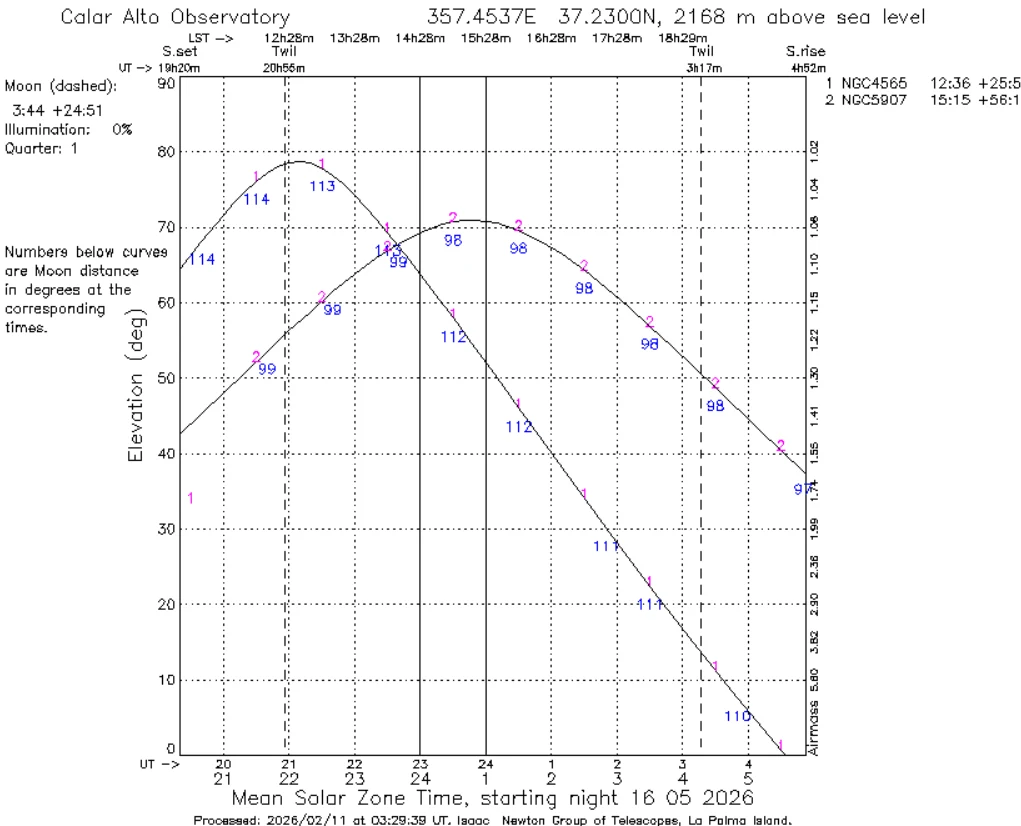
Including NGC 5907 as a second target is technically feasible in the same session, since its right ascension allows it to be observed when NGC 4565 starts to lose altitude. The visibility chart (Figure 1) shows that both galaxies are above 40° elevation for long periods of the night, which ensures moderate airmasses and minimises differential atmospheric extinction, something especially important for obtaining reliable colour gradients.
Photometric calibration will be carried out with bias frames and flats per filter, and by observing at least one field of standard stars at two different airmasses, if time allows. This strategy makes it possible to convert instrumental magnitudes into calibrated magnitudes, a necessary condition for comparing colours between filters and between both objects. The stability of the system and the instrumental homogeneity ensure that the differences observed between NGC 4565 and NGC 5907 are physical and not systematic.
Overall, the suitable angular size of the targets, the instrument’s ability to cover the whole field, the strategy of multiple dithered exposures, the depth achievable with the available aperture and the favourable visibility conditions make the proposal technically sound and feasible in a single night.
Detailed observing programme
| Object | RA (J2000) | Dec (J2000) | Magnitudes |
|---|---|---|---|
| NGC 4565 | 12:36:20.804 | +25:59:14.61 | 13.61 (B) · 12.43 (V) · 12.55 (R) · ~11.74 (I) |
| NGC 5907 | 15:15:53.687 | +56:19:43.86 | 11.4 (B) · ~10.59 (V) · ~9.7 (R) · ~10.78 (I) |
Table 2. Targets to be observed.
Description of the observing night
The astronomical night of 16 May 2026 at Calar Alto runs approximately from the end of astronomical twilight (~21:00 UT) to the start of morning twilight (~04:30–05:00 UT), which gives about 7.5–8 usable hours. The night is divided into two science blocks, optimising the altitude of each target and minimising the airmass:
- First half of the night: NGC 4565.
- Second half of the night: NGC 5907.
Both galaxies are above 40° elevation for long periods, which ensures favourable conditions of atmospheric stability and lower differential extinction.
Instrument configuration:
- Telescope: CAHA 1.23 m.
- Instrument: DLR-MKIII CCD, in direct-imaging mode.
- Filters: B, V, R and I (broadband).
- Dithering: small pattern (5–15″) between exposures.
- Binning: 1×1, to keep the structural resolution.
Calibrations:
- Bias: 20.
- Flats: 10 per filter (B, V, R and I), at dusk or dawn.
- Darks: only if the instrument requires them or if a configuration is used in which they help.
Science — NGC 4565 (first half of the night). Optimal altitude: above 60° during the first hours.
- B: 10 × 180 s = 1800 s
- V: 10 × 120 s = 1200 s
- R: 10 × 90 s = 900 s
- I: 10 × 90 s = 900 s
A small dither will be applied between frames.
Science — NGC 5907 (second half of the night). Optimal altitude: above 50° in the early morning. Exactly the same set of filters and exposure times will be used to ensure direct comparability:
- B: 10 × 180 s = 1800 s
- V: 10 × 120 s = 1200 s
- R: 10 × 90 s = 900 s
- I: 10 × 90 s = 900 s
With the same dither pattern. If saturation is detected in the nucleus, 2–3 short exposures (~30–60 s) will be added and later combined with an HDR-type technique.
Required signal-to-noise:
- S/N ≥ 50 per pixel in the central regions.
- S/N ≥ 10–15 in the outer regions, to obtain reliable μ(r) profiles.
Estimated overheads, per exposure:
- CCD readout: ~20–30 s.
- Dither offset: ~10–15 s.
- Filter change: ~20–30 s.
The additional effective time is estimated at ~20–25 % on top of the integration time. The net science time is 1800 + 1200 + 900 + 900 = 4800 s per galaxy (≈ 1.3 h), that is, 9600 s (≈ 2.7 h) for the two, without calibrations; including overheads, about 1.6–1.7 hours per target (≈ 3.3 h in total). The full night allows both targets to be covered together with the calibrations without compromising quality.
Additional comments
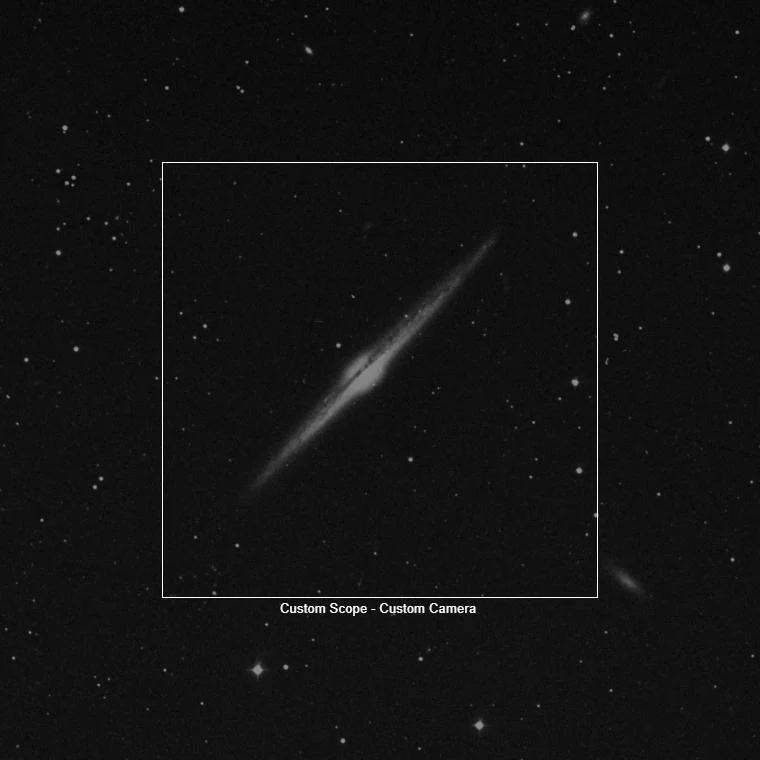
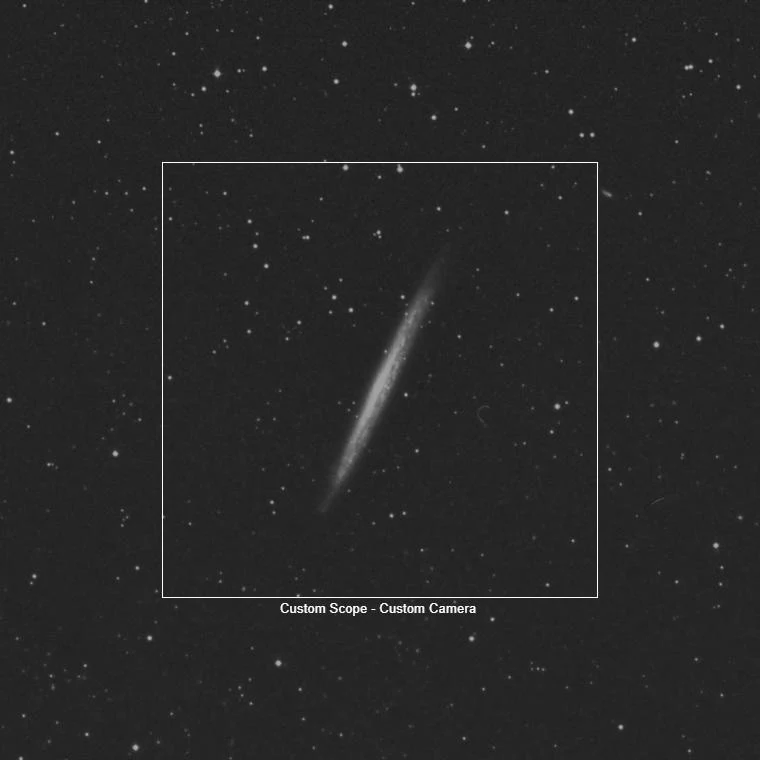
The field of view of the DLR-MKIII camera (21.4′ × 21.4′) makes it possible to frame NGC 4565 (≈ 16′ angular extent) and NGC 5907 (≈ 12–13′) completely in a single pointing, without a mosaic. For NGC 4565 there is a margin of about ~2.7′ on each side, and for NGC 5907 about ~4.5′ on each side, enough to estimate the local sky background and build surface-brightness profiles μ(r) robustly (Figures 2 and 3). The simulation in Figures 2 and 3 used a more conservative field of 0.29° (~17.4′); even with that field both galaxies fit completely, although with smaller margins (~0.7′ on each side for NGC 4565 and ~2.5′ for NGC 5907).
This proposal was accepted together with the one for KELT-23 A b; the observing campaign can be read in Six nights at the Sierra Nevada Observatory.
References
- Dalcanton, J. J., Yoachim, P., & Bernstein, R. A. (2004). The formation of dust lanes: Implications for the vertical structure of spiral galaxies. The Astrophysical Journal, 608, 189–207.
- de Jong, R. S. (1996). Near-infrared and optical broadband surface photometry of 86 face-on disk dominated galaxies. II. Radial disk color gradients. Astronomy & Astrophysics, 313, 45–64.
- Freeman, K. C. (1970). On the disks of spiral and S0 galaxies. The Astrophysical Journal, 160, 811–830.
- Kylafis, N. D., & Bahcall, J. N. (1987). Dust distribution in edge-on spiral galaxies. The Astrophysical Journal, 317, 637–650.
- Sérsic, J. L. (1963). Influence of the atmospheric and instrumental dispersion on the brightness distribution in a galaxy. Boletín de la Asociación Argentina de Astronomía, 6, 41–43.