Observation & instruments · UNIR
Photometric calibration of a CCD image
Derivation of the photometric zero point of a CCD image: source extraction with SExtractor, cross-match with the 2MASS catalogue, removal of outliers by sigma-clipping and error estimate.

Procedure
To calibrate the CCD image photometrically, its sources were extracted with SExtractor and cross-matched with the 2MASS reference catalogue for the same region. Figure 1 shows the corrected image with the 2MASS catalogue objects overlaid, and Figure 2 the original image with the catalogue generated by SExtractor.
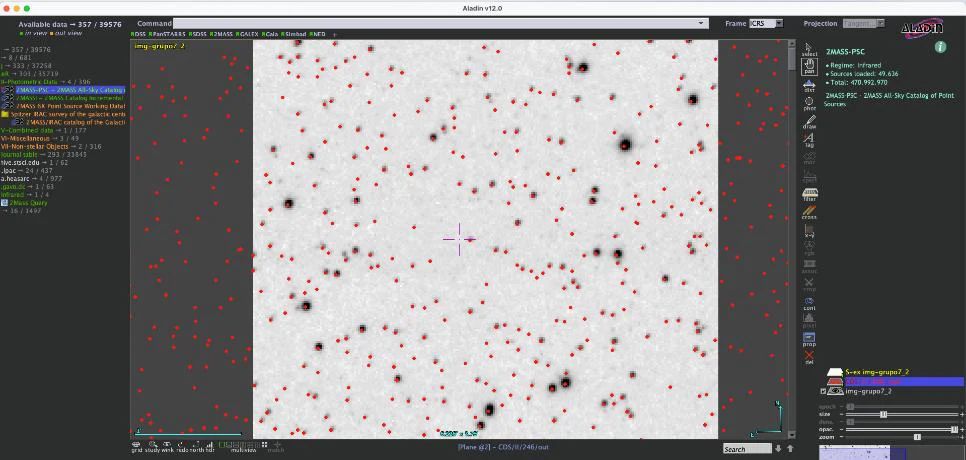
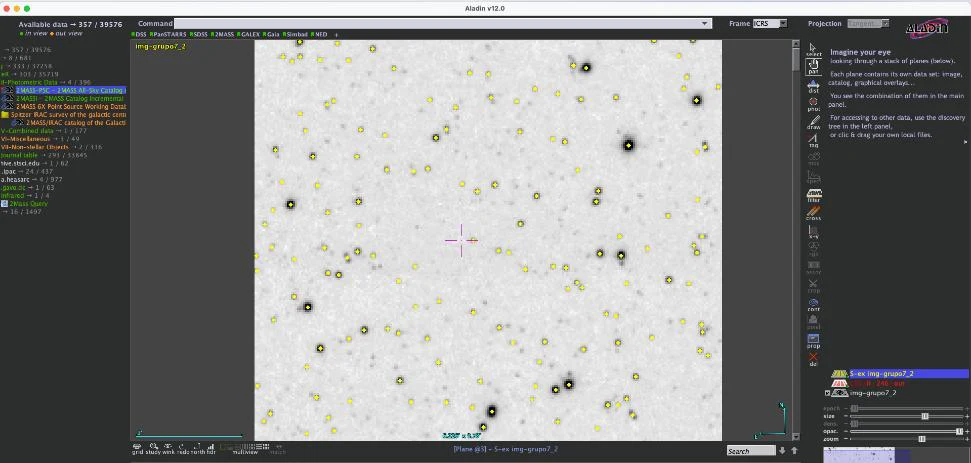
From the cross-match, in TOPCAT, the difference between the 2MASS magnitude and the instrumental magnitude, m2MASS − mI, was calculated for each star in common, and an iterative procedure for removing outliers by sigma-clipping was applied.
Result
The final distribution of the differences m2MASS − mI has:
- Mean: μ = −21.900583
- Standard deviation: σ = 0.118492305
- Number of stars: N = 161
The photometric zero point is taken as the mean of the distribution, and its uncertainty as the error of the mean:
σZP = σ / √N = 0.118492305 / √161 = 0.11849 / 12.69 ≈ 0.0093 ≈ 0.009 mag
Rounding the zero point to the same decimal place as its error:
ZP = −21.901 ± 0.009 mag
Interpretation
After applying the iterative sigma-clipping procedure for removing outliers, the distribution of the differences m2MASS − mI was modelled with a Gaussian function. The mean of that distribution was adopted as the photometric zero point of the image, and its uncertainty was estimated from the error of the mean: ZP = −21.901 ± 0.009 mag.
The standard deviation of the distribution, σ ≃ 0.118 mag, characterises the intrinsic scatter of the individual measurements used in the calibration process.