Observation & instruments · UNIR
Remote-mode observations at the Sierra Nevada Observatory
Report of a campaign with the T150 telescope (1.5 m) at the OSN: log of the six nights, data reduction, detection and characterisation of the transits of WASP-103 b and TrES-3 b, and multiband and Hα images of NGC 5907, M13, M27, M16 and M51.

Summary
This report covers the observing campaign of the ARIEL group at the Sierra Nevada Observatory (OSN), with the 1.5 m T150 telescope and the Andor iKon-L CCD camera. It has two parts: Part I is the log of the observations made and Part II describes the data reduction and its scientific conclusions. The operational detail of each night is documented separately, in the observing logbook.
The main scientific result is the detection and characterisation of two hot-Jupiter transits by differential photometry: WASP-103 b and TrES-3 b. In both cases a drop in brightness with the expected shape and depth was measured and a transit model was fitted, from which the depth, the planet-to-star radius ratio and the orbital parameters were obtained, all compatible with the published values.
In addition, multiband images (B, V, R, I and Hα) were obtained of several extended objects: the edge-on galaxy NGC 5907, the original target of the proposal; the globular cluster M13; and the nebulae and galaxies M27, M16 and M51, in which the contribution of the Hα filter, which isolates the ionised gas, is clearly visible.
For WASP-103 b, two transits of the same planet are available, observed on different dates and in different filters. Their detailed comparison, with custom Python notebooks, is planned as future work.
Introduction and aims
In January and February 2026 two observing-time proposals were submitted: one on exoplanet transit photometry, centred on KELT-23 A b with WASP-103 b as a control observation, and another on multiband photometry of edge-on spiral galaxies (NGC 4565 and NGC 5907). Both were accepted and merged into a single observing plan for the OSN.
The nights of 8, 9 and 10 May 2026 were allocated, and they were badly affected by poor weather (cloud and wind). As compensation, it was possible to observe sharing the telescope over the weekend of 22, 23 and 24 May. The observatory also provided access to archive images (a transit of WASP-103 b from 6 April 2025 and one of KELT-23 A b from 1 May 2026), which extends the material available for the analysis.
Part I. Observing log
Configuration common to all nights:
- Telescope: T150 (1.5 m).
- Location: OSN (IAA-CSIC), Sierra Nevada, Granada (37°04′ N, 03°23′ W, 2896 m).
- Camera: Andor iKon-L CCD (DZ936N-BEX2-DD), cooled to −80 °C; 16 bits; plate scale of 0.23″/pixel in 1×1 binning (0.46″/pixel in 2×2).
- Filters: Johnson–Cousins B, V, R, I, Hα and Clear.
- Software: TCS 2 Client (telescope); MaxIm DL Pro 6 (camera, management of exposure times, repeats and saving, and image processing: bias, flats, reduction and colour composition); TheSkyX (planetarium); PHD2 and runACiego (autoguiding).
All times are UTC.
Night 1: 8 May 2026
- Start and end: ≈ 18:35 (opening) – ≈ 04:00. Operator: Julio Rodrigo Campos.
- Conditions: cloudy (non-photometric sky). T ≈ 11 → 16 °C, humidity 63 %. Wind of 5 km/h at the start, with gusts of 60–65 km/h after midnight. No usable scientific data; operational validation night.
| Object | (RA, Dec) | Start UTC | Exposure | Filters | Comment |
|---|---|---|---|---|---|
| NGC 4565 | 12 36 20.8, +25 59 14.6 | ~19:30 | 120–600 s | B, V, R, I, Hα | Attempt; undetectable with a non-photometric sky (clouds). |
| Markarian 421 | 11 04 27.3, +38 12 31.8 | ~23:30 | 60–300 s | B, V, R, I | Point-like blazar detected in 2×2 binning (high-energy programme). |
| Mizar, Arcturus, Vega | — | Early morning | Short | Clear | Optical and saturation check with bright stars. |
Night 2: 9 May 2026
- Start and end: 19:38 – ≈ 20:15 (calibration). Operator: Julio Rodrigo Campos.
- Conditions: adverse weather that prevented any science. Night devoted to calibration images (bias and flats per filter and binning) and to training: demonstration of stacking and of the transit-analysis workflow with FotoDif on KELT-23 A b.
| Object | (RA, Dec) | Start UTC | Exposure | Filters | Comment |
|---|---|---|---|---|---|
| Bias 1×1 and 2×2 | — | 19:50–19:52 | 0 s | — | 22 frames (11 + 11) of electronic pedestal. |
| Flats 1×1 | Twilight | 19:38–19:47 | 4–8 s | B, V, R, I, Hα, Clear | 42 frames; one flat per filter and binning. |
| Flats 2×2 | Twilight | 19:59–20:10 | 1–10 s | B, V, R, I, Hα, Clear | 42 frames; times adjusted to avoid saturation. |
| KELT-23 A b (demonstration) | 15 28 35.2, +66 21 32 | — | — | R | Archive light curve (1 May) shown in FotoDif. |
Night 3: 10 May 2026
- Start: 21:02. End: dome closed. Operator: Julio Rodrigo Campos.
- Conditions: lower humidity, but strong wind that prevented the dome from being opened safely. The focus was checked and WASP-103 was located with Astrometry.net to have it ready; in the end the attempt was abandoned. No data.
Night 4: 22 May 2026
- Start and end: 21:31 – 03:43. Operator: Alfredo Sota.
- Conditions: excellent. Transparency close to 100 %, stable sky background, good seeing and photometric scatter of ~0.2 %. 1×1 binning for the transit (maximum resolution; the CCD has no anti-blooming). Autoguiding with runACiego to keep the star on the same pixels.
| Object | (RA, Dec) | Start UTC | Exposure | Filters | Comment |
|---|---|---|---|---|---|
| UGC 10214 | 16 06 15, +55 25 17 | 21:31:56 | 180–300 s | B, Hα, I, R | Tadpole Galaxy; 15 frames (bin 2×2). |
| NGC 4565 | 12 36 22, +25 59 14 | 22:48:27 | 120–300 s | B, V, R, I, Hα | ARIEL target; 16 frames (bin 2×2). |
| WASP-103 b | 16 37 09, +07 08 10 | 23:49:39 → 03:40:58 | 40 s | R | Transit. 306 frames, bin 1×1, cadence ~40 s, autoguiding with runACiego. |
| Bias 1×1 | — | 03:42 | 0 s | — | 10 calibration frames at closing. |
Night 5: 23 May 2026
- Start and end: 19:15 – 03:22. Operator: Alfredo Sota.
- Conditions: intermittent high cloud (more cloud than the previous night), with clear spells; stable seeing, slightly better than the day before. Differential photometry allowed a correct fit of the transit despite the clouds.
| Object | (RA, Dec) | Start UTC | Exposure | Filters | Comment |
|---|---|---|---|---|---|
| Calibration | — | 19:15–19:58 | 0–8 s | B, V, R, I, Hα, Clear | Bias and flats in 1×1 and 2×2. |
| Jupiter | 07 36 18, +22 01 00 | 21:09:47 → 21:23:38 | 1 s | Hα | 123 frames; record of the Galilean moons (bin 1×1). |
| M97 | 11 14 48, +55 01 22 | 21:43 → 01:09 | 60–120 s | Hα, V, R, I | Owl Nebula; 21 frames (bin 2×2). |
| TrES-3 b | 17 52 26, +37 32 30 | 21:56:55 → 00:07:27 | 40 s | R | Transit. 186 frames (bin 2×2). |
| Mrk 501 / Mrk 421 | 16 54 01 / 11 04 35 | 00:21 / 00:26 | 60 s | R | Blazars (high energies). |
| OP 313 | 13 10 31, +32 20 43 | 00:31:19 | 300 s | R | Distant blazar (high z); faint source. |
| UGC 10214 | 16 06 10, +55 25 20 | 01:26 → 02:25 | 200 s | B, I, R | 18 frames; reframed for the tidal tail. |
| NGC 5907 | 15 15 52, +56 19 55 | 02:43 → 03:22 | 120–180 s | B, V, R, I, Hα | ARIEL target; 16 frames (bin 2×2). |
Night 6: 24 May 2026
- Start and end: 21:10 – 03:23. Operator: Alfredo Sota.
- Conditions: variable. Session devoted to the Solar System (Jupiter in Hα, comet 24P and the dwarf planet Haumea), to blazar monitoring (second night, to study their variability) and to extended objects (NGC 5907, M13, M27, M16 and M51).
| Object | (RA, Dec) | Start UTC | Exposure | Filters | Comment |
|---|---|---|---|---|---|
| Jupiter | 07 37 00, +21 59 26 | 21:10:23 → 21:13:30 | 1 s | Hα | 30 frames; moons in different positions from the 23rd. |
| Mrk 501 / Mrk 421 | — | 22:06 / 22:10 | 60 s | R | Blazars; second night, variability check. |
| OP 313 / 1ES 1218 | 13 10 38 / 12 21 32 | 22:14 / 22:21 | 300 s | R | Blazars (high energies). |
| 24P/Schaumasse | 14 19 21, −02 23 43 | 22:33 → 22:52 | 120 s | R | Comet; 10 frames. |
| NGC 5907 | 15 15 59, +56 20 07 | 23:01 → 00:31 | 120–180 s | B, V, R, I, Hα | ARIEL target; 33 frames. |
| M13 | 16 41 47, +36 27 30 | 00:48 | 60 s | B, I, R | Globular cluster. |
| M27 | 19 59 44, +22 43 06 | 01:12 → 01:37 | 60–180 s | B, V, R, I, Hα | Dumbbell Nebula. |
| Haumea | 14 39 46, +14 43 19 | 01:46 → 02:43 | 60 s | R | Dwarf planet. |
| M16 / M51 | — | Early morning | 60–180 s | B, V, R, I, Hα | Eagle Nebula and Whirlpool Galaxy. |
Part II. Scientific results
1. Reduction methodology
The reduction follows the standard CCD photometry workflow: first each image is corrected for the defects of the instrument, and then the relative magnitude of the stars is measured on it or the final image of the extended objects is composed.
- Calibration. A master bias and a master flat per filter and binning are built, combining the frames by median (which removes cosmic rays), and the correction (image − bias) / flat is applied. No darks are used: at −80 °C and with 30–60 s exposures, the dark current is negligible.
- Transits. During the night the curve was followed in real time with FotoDif. The final reduction was done with AstroImageJ using differential aperture photometry: the flux of the host star is measured relative to several comparison stars in the same field, which cancels the atmospheric extinction. With an automatic variable aperture and the fit of a transit model (including limb darkening), the depth, the radius ratio Rp/R, the semi-major axis a/R, the inclination i and the mid-transit time Tc are obtained.
- Extended objects. The frames of each filter are aligned and median-stacked, the colour (RGB) image is composed from the broad bands, and the Hα signal is enhanced separately.
- Independent check. Besides AstroImageJ, custom curves were generated with a Python notebook to reproduce and check the results independently; these results require more work and are not presented in this report.
2. Exoplanet transits
A transit is the periodic dimming of a star when one of its planets passes in front of it. The depth of the drop is equal to the ratio between the area of the planet and that of the star, that is, (Rp/R*)², from which the relative size of the planet is obtained directly. Fitting the full shape of the curve also recovers the inclination of the orbit, the duration and the mid-transit time.
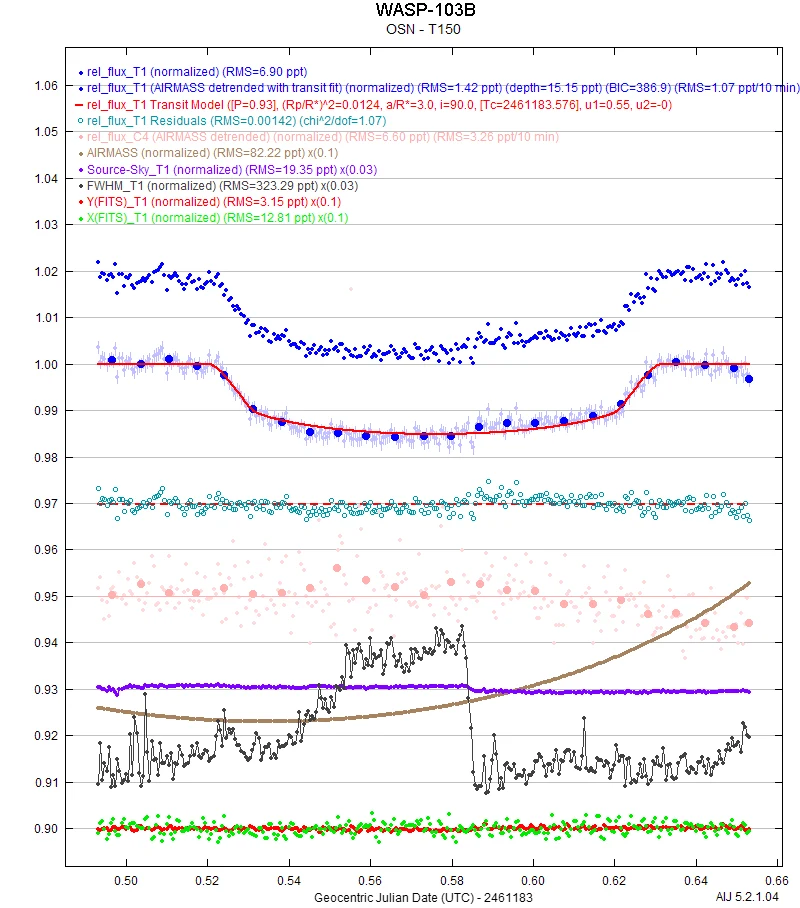
WASP-103 b (22 May, R filter). WASP-103 b is a hot Jupiter on a very short orbit (period of 0.925 days) around an F-type star. The curve shows a clean, well-defined transit. The AstroImageJ fit gives a depth of 15.15 ppt (1.52 %) and a model with (Rp/R)² = 0.0124, that is, Rp/R ≈ 0.111, with a/R ≈ 3.0, inclination i ≈ 90° (central transit) and mid-transit time Tc (BJD) = 2461183.576. The scatter of the residuals is only 1.42 ppt, much smaller than the depth, which confirms that the detection is robust. The value of Rp/R is compatible with the published one (≈ 0.115; Gillon et al., 2014) and implies, with R ≈ 1.44 R☉ (Gillon et al., 2014), a planetary radius of about 1.55 Jupiter radii, consistent with the published value (~1.53 RJ). The fitted depth (15.15 ppt) is somewhat larger than (Rp/R)² = 12.4 ppt because of limb darkening, which deepens the centre of the transit. An inclination of 90° gives the best fit to these data; the published value is about 86° (Gillon et al., 2014).
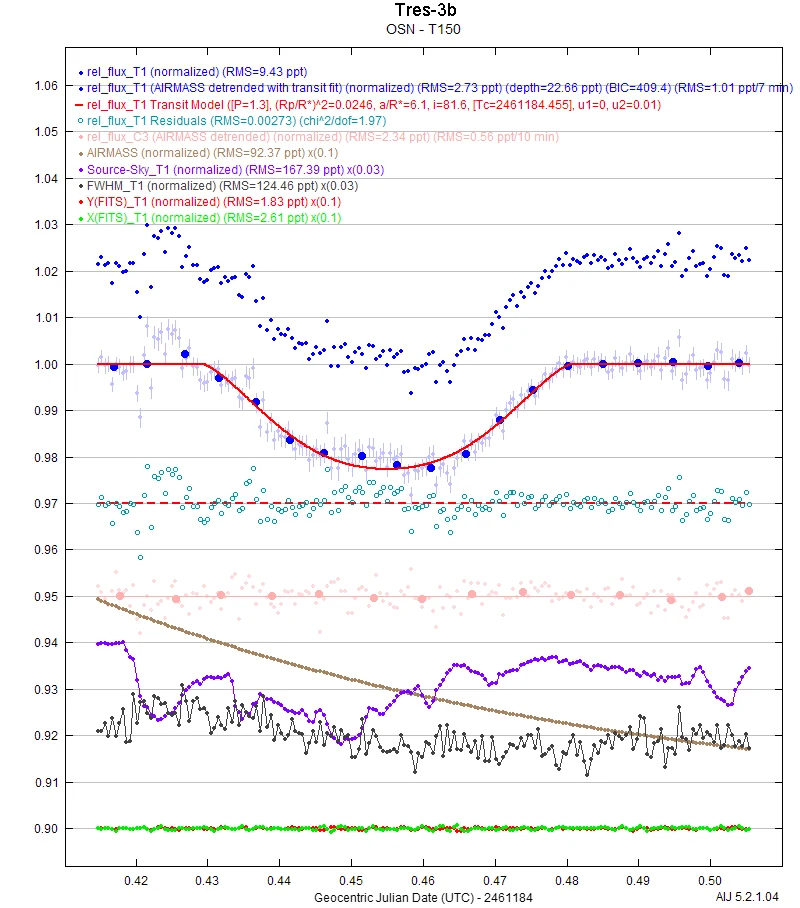
TrES-3 b (23 May, R filter). TrES-3 b is another hot Jupiter (period of 1.31 days) around a G-type star. Its transit is shorter and deeper than that of WASP-103 b. The fit gives a depth of 22.66 ppt (2.27 %) and (Rp/R)² = 0.0246, that is, Rp/R ≈ 0.157, with a/R ≈ 6.1, inclination i ≈ 81.6° and mid-transit time Tc (BJD) = 2461184.455, with a residual scatter of 2.73 ppt. These values agree very well with the literature (Rp/R ≈ 0.166 and i ≈ 81.9°; O’Donovan et al., 2007) and correspond to a planet of about 1.3 Jupiter radii. This observation was made in 2×2 binning, and differential photometry made it possible to recover the signal despite the intermittent cloud of the night.
The following tables summarise the measured parameters and compare them with the reference values from the literature.
| System | Depth | (Rp/R*)² | Rp/R* | a/R* | i (°) |
|---|---|---|---|---|---|
| WASP-103 b (R) | 15.15 ppt | 0.0124 | 0.111 | 3.0 | 90.0 |
| TrES-3 b (R) | 22.66 ppt | 0.0246 | 0.157 | 6.1 | 81.6 |
Table 1. Parameters measured with AstroImageJ.
| System | P (days) | Rp/R* (lit.) | Depth (lit.) | Host star |
|---|---|---|---|---|
| WASP-103 b | 0.925545 | ~0.115 | ~1.2–1.4 % | F8 V, Teff ≈ 6110 K, V ≈ 12.1 |
| TrES-3 b | 1.306186 | ~0.166 | ~2.6–2.9 % | G, i ≈ 81.9°, V ≈ 12.4 |
Table 2. Reference values from the literature.
3. Extended objects
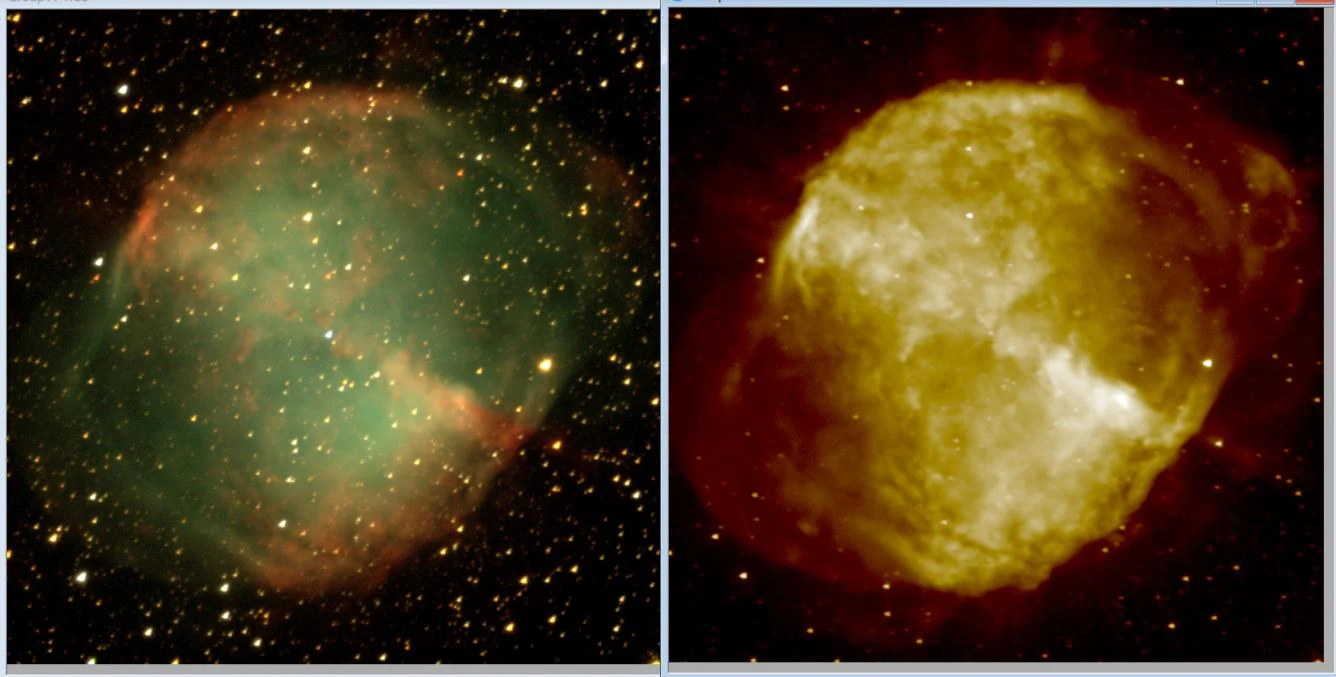
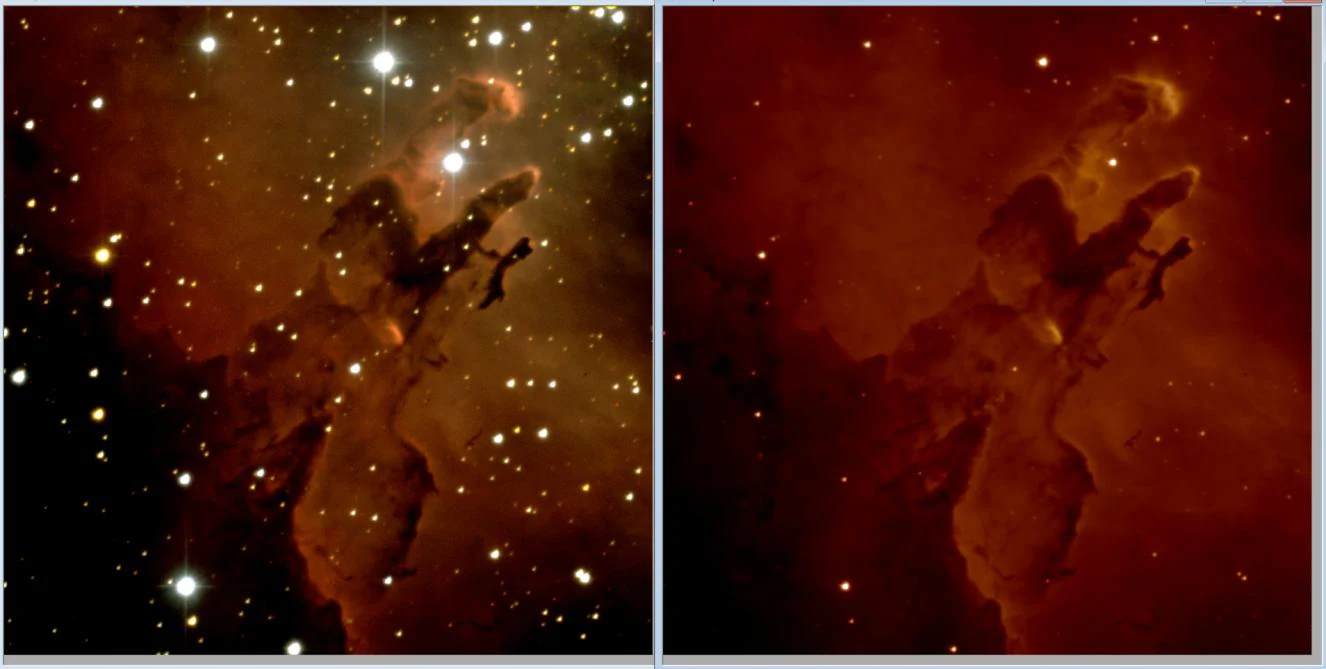
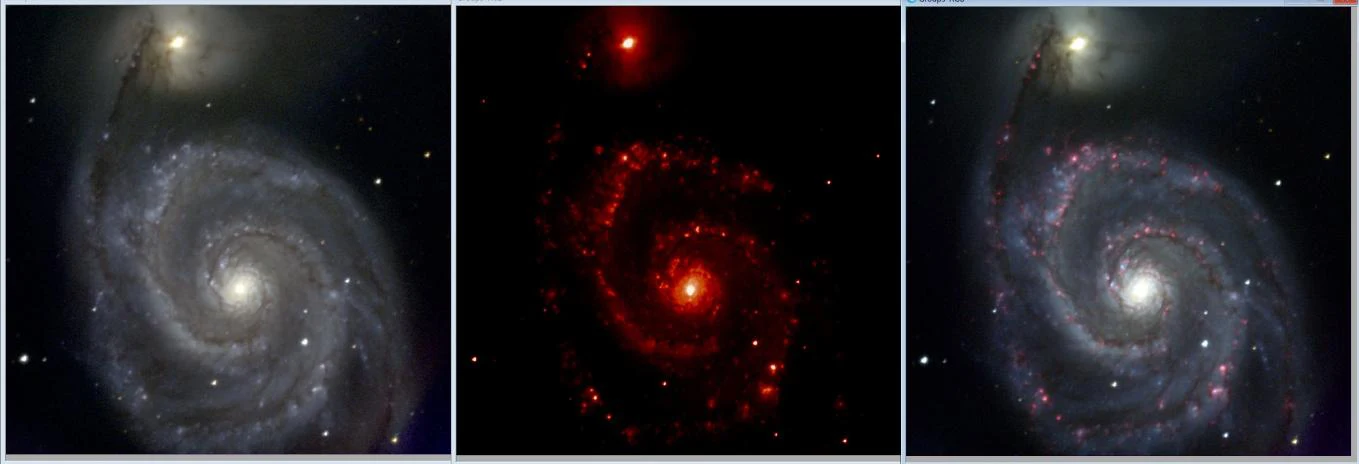
During the campaign, several extended objects were observed in different bands. Besides the colour (RGB) image, for the nebulae and star-forming galaxies the narrow Hα filter was used, which isolates the emission of ionised hydrogen at 656.3 nm and reveals structures (HII regions, gas shells) that are barely visible in the broad bands.
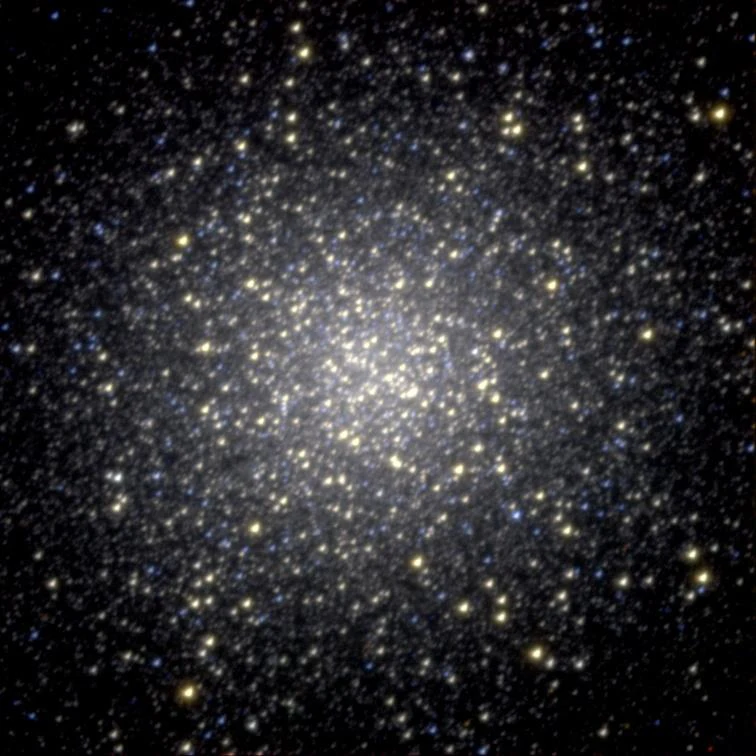
M13. M13 is a globular cluster in the constellation of Hercules, made up of hundreds of thousands of old stars, which in the image appears resolved almost to the centre. A clear diversity of colours stands out, reflecting the evolutionary state of the cluster: yellowish and orange stars predominate, corresponding to red giants (old, cool, expanded stars), and, in contrast, bluish points can be seen that correspond to hotter stars, typical of the horizontal branch or of the so-called blue stragglers.
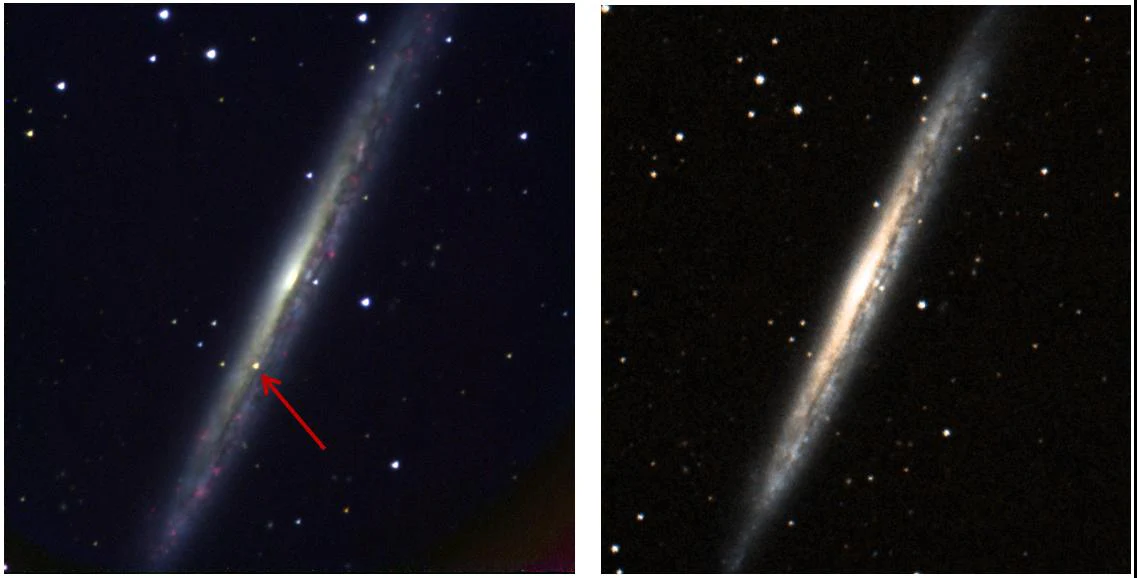
NGC 5907. NGC 5907 is a spiral galaxy seen almost exactly edge-on, whose dust lane darkens the plane of the disc. It is the original target of the extended-object proposal, intended to study the separation between bulge and disc. Comparing the observation with the DSS2 archive images, a new source is detected on the disc: the supernova SN 2026kid, discovered on 22 April 2026 by Yasuo Sano and spectroscopically classified as type II (Transient Name Server, 2026), as the operator pointed out.
M27, M16 and M51: RGB–Hα comparison. For these three objects both the colour image and the Hα image are available, which shows directly where the ionised gas is.
4. Future work
The most promising aspect of the data is that two transits of the same planet, WASP-103 b, are available: the one observed on 22 May 2026 in the R filter and an archive one from 6 April 2025 in the Clear filter. Given more time, both will be compared with custom Python notebooks: they will be phase-folded, the times of minimum (O−C) will be analysed against the published ephemeris to check their consistency, and the small difference in depth between filters, attributable to limb darkening, will be studied. Having the same transit at two epochs and in two different filters makes it possible to verify that the signal is astrophysical and not instrumental, an exercise rarely done at this level.
As for the extended objects, the full reduction of the surface photometry of NGC 5907 (isophotes, surface-brightness profiles, bulge–disc decomposition and colour gradients) remains pending, as does the photometry of SN 2026kid, which requires careful photometric calibration. Finally, the photometry of the observed blazars (Mrk 421, Mrk 501 and OP 313) can be added to the historical series of the high-energy programme.
Conclusions
The campaign met its scientific aims despite the poor weather of the nights originally allocated. Two hot-Jupiter transits, WASP-103 b and TrES-3 b, were detected and characterised; their depths, radius ratios and orbital parameters agree with the literature, which validates the reduction procedure and the suitability of the T150 telescope for precision photometry.
Multiband images were also obtained of several extended objects (NGC 5907, M13, M27, M16 and M51), in which the comparison between the broad bands and the Hα filter makes it possible to locate the ionised gas and the star-forming regions. Having two transits of WASP-103 b opens the door to a comparative study, which will be tackled as future work with custom tools. The operational detail of each night is in the observing logbook.
With thanks to the OSN operators, Julio Rodrigo Campos and Alfredo Sota.
References
- Gillon, M., et al. (2014). WASP-103 b: A new planet at the edge of tidal disruption. Astronomy & Astrophysics, 562, L3.
- Johns, D., et al. (2019). KELT-23Ab: A hot Jupiter transiting a near-solar twin. The Astronomical Journal, 158, 78.
- O’Donovan, F. T., et al. (2007). TrES-3: A nearby, massive, transiting hot Jupiter in a 31 hour orbit. The Astrophysical Journal, 663, L37.
- Transient Name Server (2026). SN 2026kid (AT 2026kid). International Astronomical Union.
- ARIEL group (2026). OSN observing logbook, May 2026. Internal document.