Observation & instruments · UNIR
Ground-based transit photometry of hot Jupiters: instrumental validation and study of the transit of KELT-23 A b
Observing-time proposal for the T150 telescope (1.5 m) at the Sierra Nevada Observatory: the full transit of KELT-23 A b, preceded by partial monitoring of WASP-103 b as a control observation.

Basic information
Abstract. A ground-based photometric observing campaign of exoplanet transits is proposed, with the aim of obtaining a high-quality light curve of the hot Jupiter KELT-23 A b. The observing night will begin with partial monitoring of the transit of WASP-103 b, which will be used as a control observation to validate instrumental stability, optimise the cadence and assess the photometric conditions before the main event. The full transit of KELT-23 A b will make it possible to analyse the depth and morphology of the transit signal, as well as to check the consistency of the parameters published in the literature. The observing strategy gives priority to temporal continuity and to obtaining an extended baseline before and after the transit, maximising the achievable photometric precision. The resulting data will form a homogeneous, well-characterised data set, suitable for future comparative studies of giant exoplanets close to their host stars.
Observatory, telescope and instrument. Sierra Nevada Observatory (Spain), T150 telescope (1.5 m), Andor iKon-L CCD camera.
Observational details
Time requested. One observing night.
| Optimal dates | Acceptable dates | Unacceptable dates |
|---|---|---|
| Night of 6 to 7 June 2026 | Night of 10 to 11 May 2026 | 8, 9, 22, 23 and 24 May 2026 |
Table 1. Dates requested.
Justification of the number of nights and the dates. A single observing night, 6 June 2026, is requested to cover the transit of the exoplanet KELT-23 A b completely. A control observation will be carried out beforehand by partially monitoring WASP-103 b. This planning ensures a continuous light curve, with a sufficient baseline and no time overlaps, optimising the use of telescope time and ensuring the technical and scientific feasibility of the proposal.
Weather and sky-quality conditions. Photometric sky conditions are required, or very thin cirrus at most, without rapid changes in transparency. The Moon will be about 65 % illuminated, at a large angular separation from the targets, with a limited impact. Seeing ≤ 1.5″ and stable atmospheric extinction throughout the night are acceptable.
Technical details
Instrument configuration. Andor iKon-L camera (DZ936N-BEX2-DD) installed on the T150 telescope of the Sierra Nevada Observatory. The camera’s standard readout mode will be used: 1 MHz readout speed, gain ×1 and high-sensitivity mode, with 1×1 binning, which gives a scale of 0.232″/pixel and a field of view of 7.92′ × 7.92′. This configuration gives priority to maximum spatial resolution and photometric stability, with a readout time of about 4 s per image. The camera will operate at a temperature of −80 °C or lower, so that the dark current is negligible compared with the readout noise.
The main filter will be Johnson–Cousins R, selected for its high photometric efficiency, its lower sensitivity to atmospheric extinction and its lower dependence on seeing variations, characteristics that are especially favourable for transit observations.
The exposure time will be determined by imposing a minimum signal-to-noise ratio of SNR ≥ 40 per image, using the standard photometric SNR expression, which takes into account the detector readout noise, the sky background and the number of pixels in the photometric aperture, defined from the seeing of the night. The final exposure time will be adjusted iteratively at the start of the observation with test exposures, ensuring at the same time an adequate cadence and avoiding detector saturation.
Scientific justification
The transit method is one of the most robust and widely used techniques for detecting and characterising exoplanets. From the periodic dimming of the stellar flux that occurs when a planet passes in front of its host star, it is possible to determine fundamental parameters of the system, such as the relative planetary radius, the orbital inclination and the transit duration. The quality of this information depends critically on photometric precision, on the temporal continuity of the observation and on the control of systematic effects of instrumental and atmospheric origin.
In this context, hot Jupiters are especially suitable targets for ground-based photometry. Their large size and proximity to the host star produce relatively deep, short transits, detectable even with medium-sized telescopes. These systems make it possible not only to validate published ephemerides but also to assess the stability and performance of instruments in long observing campaigns.
The main aim of this proposal is the observation of the transit of KELT-23 A b, a hot Jupiter orbiting a G-type star. This system has been characterised previously with ground-based photometric observations, with well-defined orbital parameters and a transit depth suitable for high-precision studies (Johns et al., 2019). KELT-23 A b was chosen as the main target because of its favourable geometry, the high probability of detecting a full transit on the selected night and its good elevation above the horizon during the event, factors that minimise atmospheric extinction and improve the signal-to-noise ratio of the light curve.
A full light curve of KELT-23 A b will make it possible to analyse the depth and morphology of the transit, as well as to check the consistency of the published parameters. Observations of this kind are especially relevant for consolidating exoplanet catalogues and for providing homogeneous data sets obtained with ground-based instrumentation, usable in later comparative studies. Independent observational validation of well-known systems is a common practice in observational astronomy and a fundamental step in ensuring the reliability of the models and of the derived parameters.
As part of the observing strategy, partial monitoring of the transit of WASP-103 b during the same night is also proposed. WASP-103 b is an ultra-hot Jupiter orbiting extremely close to its host star, very near its Roche limit (Gillon et al., 2014). Previous studies have shown that this planet is subject to intense tidal forces and extreme stellar irradiation, which makes it a system of great dynamical and evolutionary interest (Gillon et al., 2014). In this proposal, the partial transit of WASP-103 b is not intended as a second main scientific target but as a preliminary control observation, aimed at assessing instrumental stability, the achievable photometric quality and the behaviour of the system under real conditions before the main event.
Including a control observation responds to a clear methodological need: high-precision photometry is very sensitive to variations in seeing, atmospheric transparency and detector performance. Monitoring a partial transit with a depth comparable to that of the main target makes it possible to adjust the cadence, the exposure times and the data-reduction strategy, minimising the risks during the critical observation of the full transit of KELT-23 A b. This approach is common in real campaigns and helps to maximise the scientific quality of the data.
From a broader point of view, the proposal is framed within the comparative study of giant exoplanets close to their host stars. Having light curves obtained under homogeneous instrumental conditions makes it possible to analyse how factors such as transit depth, event duration and orbital geometry influence the detectability and the photometric precision achievable from the ground. Recent work has highlighted the importance of a careful treatment of these parameters to reduce biases in the determination of planetary radii and to improve the reliability of exoplanet catalogues (Petigura, 2020).
The choice of the T150 telescope at the Sierra Nevada Observatory and the Andor iKon-L CCD camera is directly linked to these aims. The telescope aperture provides an adequate signal-to-noise ratio for stars of intermediate magnitude, while the stability and field of view of the detector allow differential photometry with several comparison stars in the same frame. The selection of the Cousins R filter helps to reduce the effects of atmospheric extinction and scintillation, which are critical in long observations.
Overall, the proposed observation will provide a quality photometric data set, centred on a well-defined full transit and supported by a preliminary control observation. These data will not only make it possible to verify published parameters and to assess the performance of the available instrumentation, but will also form a solid basis for future comparative studies of giant exoplanets, contributing to the development of increasingly robust analysis frameworks in exoplanetary astrophysics.
Technical justification
The technical feasibility of the proposal rests on the suitability of the selected instrumentation and on the compatibility of the observational aims with the capabilities of the telescope requested. The T150 telescope (1.5 m) of the Sierra Nevada Observatory, equipped with the Andor iKon-L CCD camera, offers an optimal combination of aperture, stability and sensitivity for high-precision differential photometry of point sources of intermediate magnitude.
The main target, KELT-23 A b, transits a star bright enough to reach high signal-to-noise ratios with moderate exposure times, which allows a cadence adequate for correctly resolving the ingress, full transit and egress phases. The depth and duration of the transit make the event especially robust against the usual limitations of ground-based photometry, such as atmospheric variability or scintillation.
The Andor iKon-L detector has low readout noise and good thermal stability, essential characteristics for continuous observations lasting several hours. Its field of view makes it possible to include several comparison stars of similar brightness in the same frame, a fundamental requirement for minimising systematic effects through differential photometry. The 1×1 binning ensures maximum spatial resolution and avoids degrading the signal under moderate seeing.
The choice of the Cousins R filter is technically justified by its lower sensitivity to atmospheric extinction and seeing variations compared with bluer bands, something especially relevant in long observations. In addition, this filter maximises the signal received from Sun-like stars, which improves the stability of the light curve.
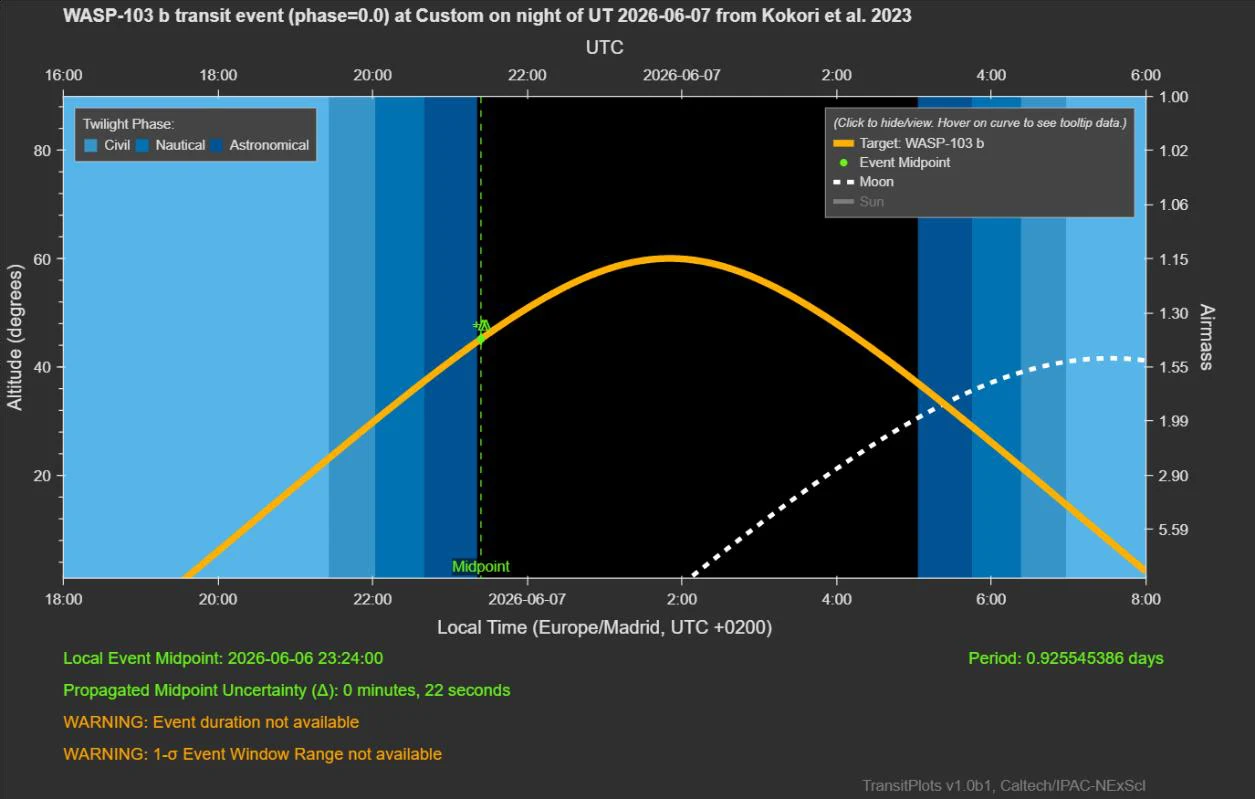
The partial observation of the transit of WASP-103 b at the start of the night is technically feasible and does not interfere with the main transit of KELT-23 A b, since the two events do not overlap in time. This preliminary monitoring will make it possible to check that the instrumentation works correctly, adjust the exposure times and assess the photometric stability under the real conditions of the night, reducing the risks during the critical observation of the full transit.
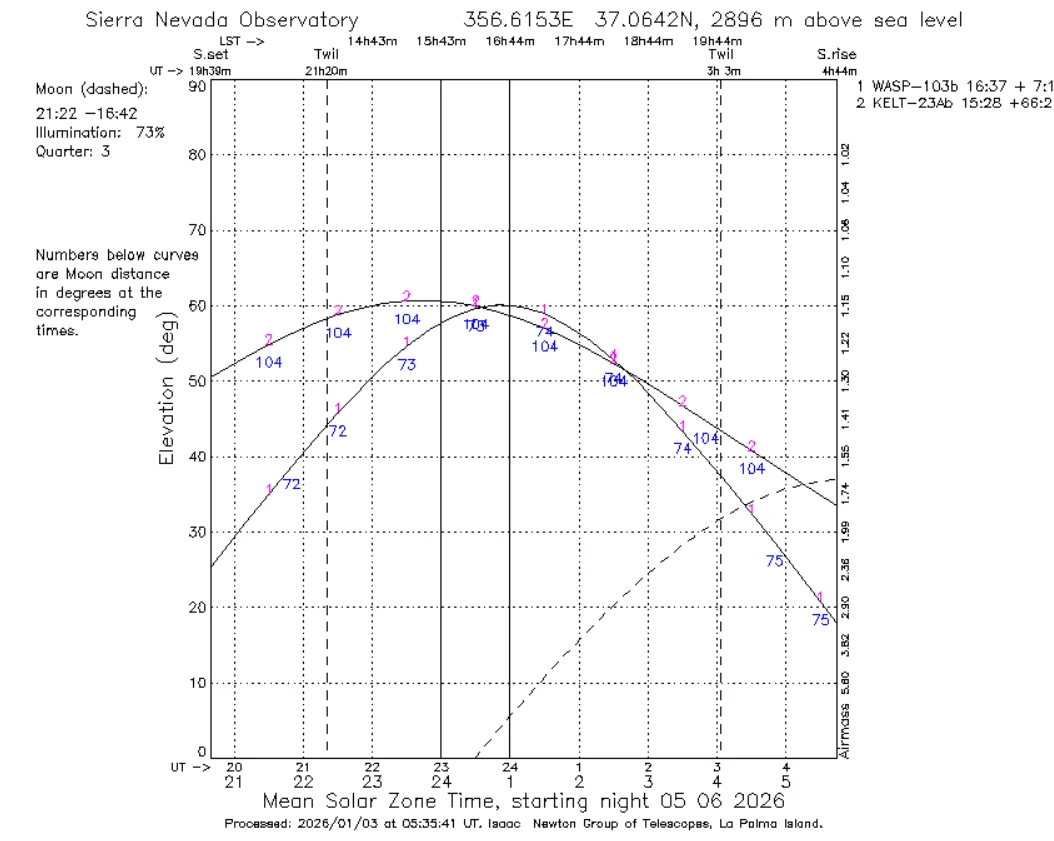
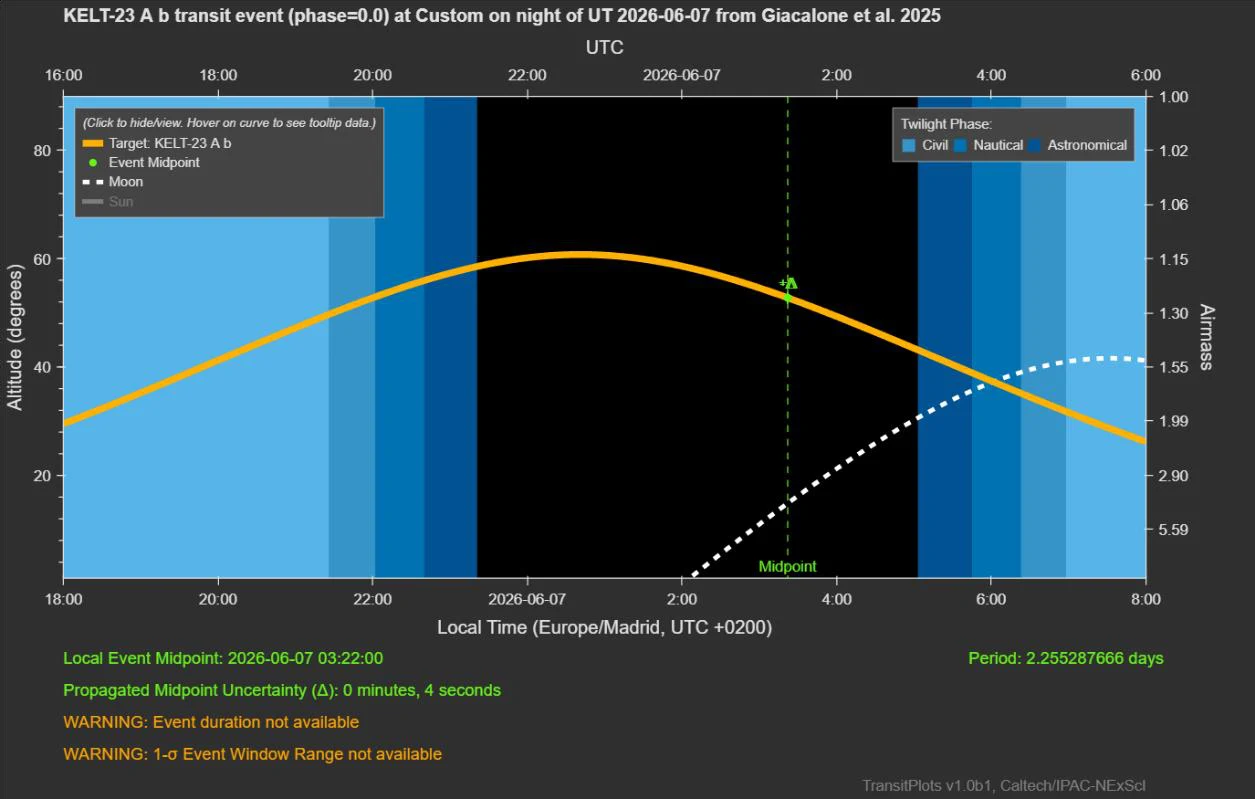
The visibility simulations indicate that KELT-23 A b is above 50° elevation for most of the transit, with low and stable airmass values. This ensures that atmospheric extinction and atmospheric distortions do not compromise the quality of the data. The length of the available astronomical night comfortably covers the main event, including an extended baseline before and after the transit, as well as the standard calibrations (bias, darks and flats).
Overall, the characteristics of the telescope, the detector and the time planning ensure that the proposed observations are technically feasible and that the data obtained will meet the requirements for precise, scientifically useful transit photometry.
Detailed observing programme
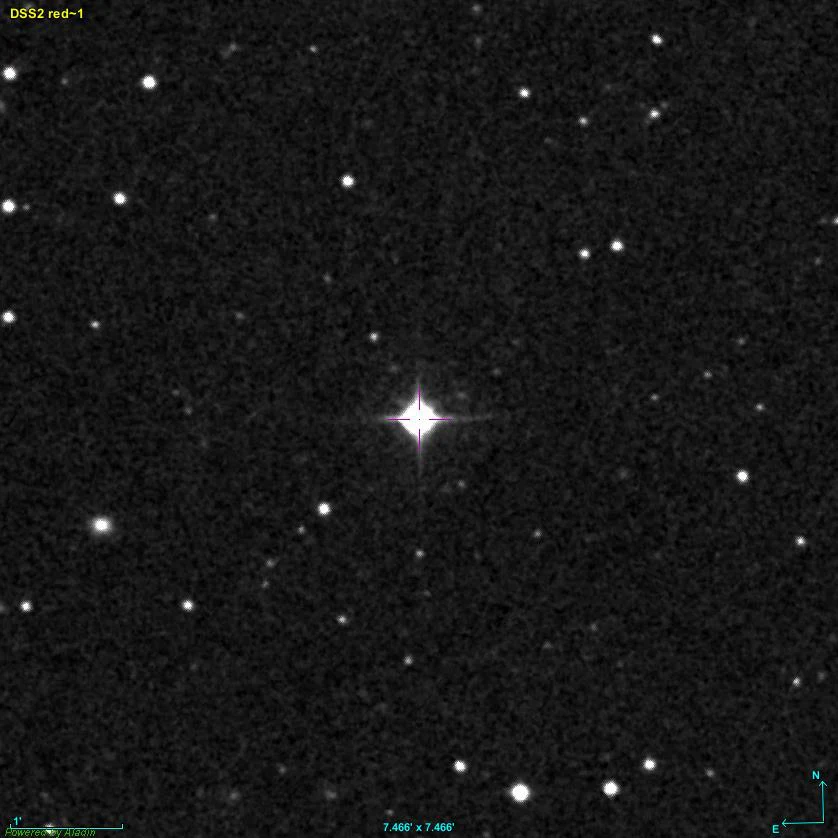
The observing night is structured around a main event, the full transit of KELT-23 A b, and a secondary target observed partially at the start of the night, WASP-103 b, in order to optimise the use of the available time and to have comparative data under similar instrumental conditions. The following table lists, in order of observation, the host stars of the exoplanets to be observed.
| Object | RA | Dec | Equinox | Magnitude |
|---|---|---|---|---|
| WASP-103 | 16:37:15.6 | +07:11:00.2 | J2000 | V ≈ 12.1 and R ≈ 11.8 |
| KELT-23 A | 15:28:35.19 | +66:21:31.5 | J2000 | V ≈ 10.31 and R ≈ 10.24 |
Table 2. Host stars of the exoplanets to be observed.
Description of the observing night (6 June 2026)
During the astronomical night, the photometric observation of the transit of the exoplanet KELT-23 A b will be carried out. WASP-103 b will be observed beforehand as a control object, in order to verify instrumental stability, optimise the cadence and assess the photometric conditions before the main event.
The observations will be made in the Johnson–Cousins R filter, starting about 30 minutes before the predicted start of the transit and ending 30 minutes after its end, to ensure a correct determination of the out-of-transit level. The initial exposure time will be set at 20 s and adjusted, if necessary, up to a maximum of 60 s if the SNR is below 40. The integration time will be adjusted while keeping a cadence adequate for sampling the full transit and avoiding detector saturation, taking into account the readout time of the camera.
The calibrations will include bias frames, darks with the same exposure times as the science images and sky flats in the R filter.
This proposal and another on edge-on galaxies were accepted; the observing campaign can be read in Six nights at the Sierra Nevada Observatory.
References
- Gillon, M., Anderson, D. R., Collier Cameron, A., et al. (2014). WASP-103 b: A new planet at the edge of tidal disruption? Astronomy & Astrophysics, 562, L3.
- Johns, D., Reed, P. A., Rodriguez, J. E., et al. (2019). KELT-23Ab: A hot Jupiter transiting a near-solar twin close to the TESS and JWST continuous viewing zones. The Astronomical Journal, 158(2), 78.
- NASA Exoplanet Archive (2025). Caltech/IPAC.
- Petigura, E. A. (2020). Two views of the radius gap and the role of light curve fitting. The Astronomical Journal, 160(2), 89.