Planetary systems · UNIR
Observational extrapolation and estimate of potentially habitable planets in the Milky Way with the partial Drake equation
A reduced version of the Drake equation, with parameters from the literature and own observations with Slooh, to answer a bounded question: how many potentially habitable environments are there in our galaxy?

Introduction
The question “are we alone?” has accompanied humanity since Antiquity. In recent decades, however, it has stopped being asked only in philosophical and speculative terms and has entered the quantitative and statistical domain of science, in particular of observational astrophysics.
Since the discovery of the first exoplanet around a Sun-like star in 1995 (Mayor and Queloz, 1995), the number of confirmed worlds has kept growing exponentially thanks to space missions such as Kepler and TESS, which have detected thousands of exoplanets (more than 6000 confirmed since 2025, according to the NASA Exoplanet Archive) and made it possible to characterise their frequency statistically for different types of stars and orbital ranges. This progress has opened up the possibility of approaching the question within a probabilistic framework.
This work uses a reduced version of the Drake equation to estimate the number of potentially habitable planets in the Milky Way. The analysis is based on observations made in the Slooh environment and on estimates published in the recent scientific literature. The main aim is not to estimate the number of technological civilisations but to quantify, with the data that can be trusted today, a first level of this problem and to answer the following question: how many potentially habitable environments are there in our galaxy?
This work is also the scientific basis of the talk Are we alone in the universe?.
The Milky Way as an astrobiological environment
The Milky Way is a barred spiral galaxy of type Sbc, with a diameter of about 150,000 light years and a stellar population of about
N* ≈ 2.5 × 10¹¹
stars, that is, roughly 250 billion (Licquia and Newman, 2015).
Spiral galaxies such as the Milky Way or Andromeda (M31) have active star-forming regions thanks to their spiral arms, rich in dust and gas, which allow new stars to be created constantly. They therefore host a very varied stellar population, from young, massive stars to old, low-mass ones. This environment is essential for astrobiology, since planet formation is directly linked to stellar evolution. In addition, the metallicity of stellar populations plays a key role in the formation of rocky planets, which connects the chemical evolution of the galaxy with the probability of habitability.
Exoplanets and the habitable zone
An exoplanet is a planet orbiting a star other than the Sun. The habitable zone is defined as the region around a star in which water can remain liquid under certain atmospheric conditions. Not every planet in this zone (also known as the “Goldilocks zone”) will be habitable for life forms like those known today; even so, it is a good first approximation, with a physico-chemical basis, for searching for worlds similar to ours.
The Drake equation
In 1961 Frank Drake, an astronomer at Cornell University, proposed a conceptual tool for estimating the number of technologically communicative civilisations in our galaxy:
N = R* · fp · ne · fl · fi · fc · L
where:
- R* is the star formation rate.
- fp is the fraction of stars with planets.
- ne is the number of potentially habitable planets per star with planets.
- fl is the fraction of these on which life arises.
- fi is the fraction on which intelligence arises.
- fc is the fraction that develops communicative technology.
- L is the communicative lifetime.
The first three variables can now be estimated with astronomical data, whereas the rest are uncertainties linked to biology and sociology that remain unknown to date. This work considers only the astronomical part of the equation:
Nhab = N* · fp · ne
where N* is the total number of stars in the galaxy. The first term has been modified to adapt the original formulation, which uses the star formation rate R*, to an estimate of the current total stellar content of the galaxy. Instead of considering how many stars form per unit of time, the total number of existing stars is used, which allows the calculation to be applied both on a galactic scale and to a small field of the sky. From there, it is possible to estimate what fraction of those stars host planetary systems and how many of those planets lie within the habitable zone.
The following values were adopted, based on estimates widely cited in the literature:
- Total number of stars in the Milky Way: N* = 2.5 × 10¹¹ (Licquia and Newman, 2015).
- Fraction of stars with planetary systems: fp ≈ 1 (Cassan et al., 2012).
- Mean number of potentially habitable planets per system: ne = 0.22 (Petigura et al., 2013). Strictly, this value is the fraction of Sun-like stars (G and K) with Earth-sized planets in their habitable zone; applying it to all the stars in the galaxy, most of them M dwarfs, is a working hypothesis worth bearing in mind.
These parameters represent the “astronomical” stretch of the problem and allow a quantitative estimate to be built without introducing biological or sociological variables, which today carry much larger uncertainties.
Observations with Slooh
To connect the model with observational evidence, images were taken with the Slooh platform as part of the mission AST: Are We Alone. The observations were organised to illustrate four pieces of the reasoning.
1. A spiral galaxy analogous to the Milky Way as context.
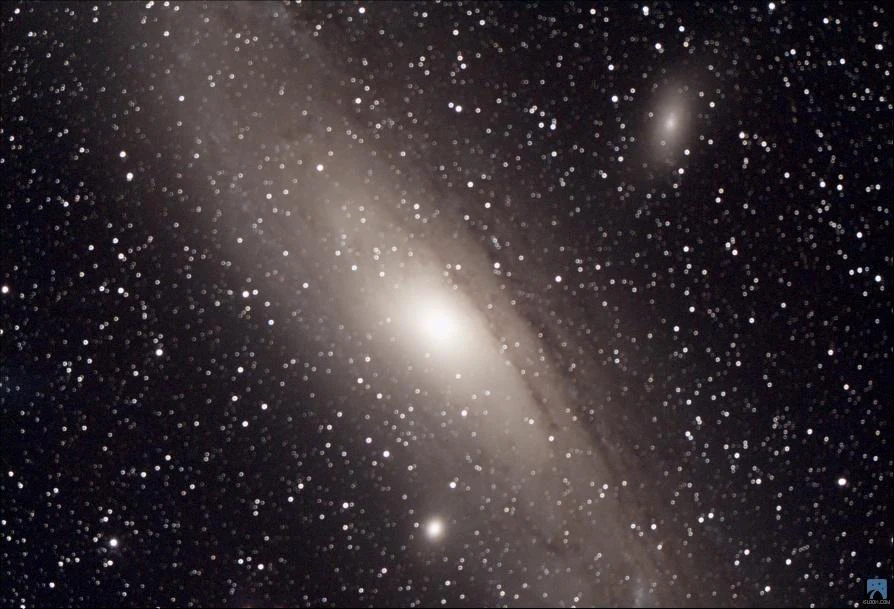
The observation of M31 was used as a morphological reference of a spiral galaxy comparable to the Milky Way, providing a visual context for discussing star formation and the abundance of planetary environments.
2. A star with a confirmed exoplanet.
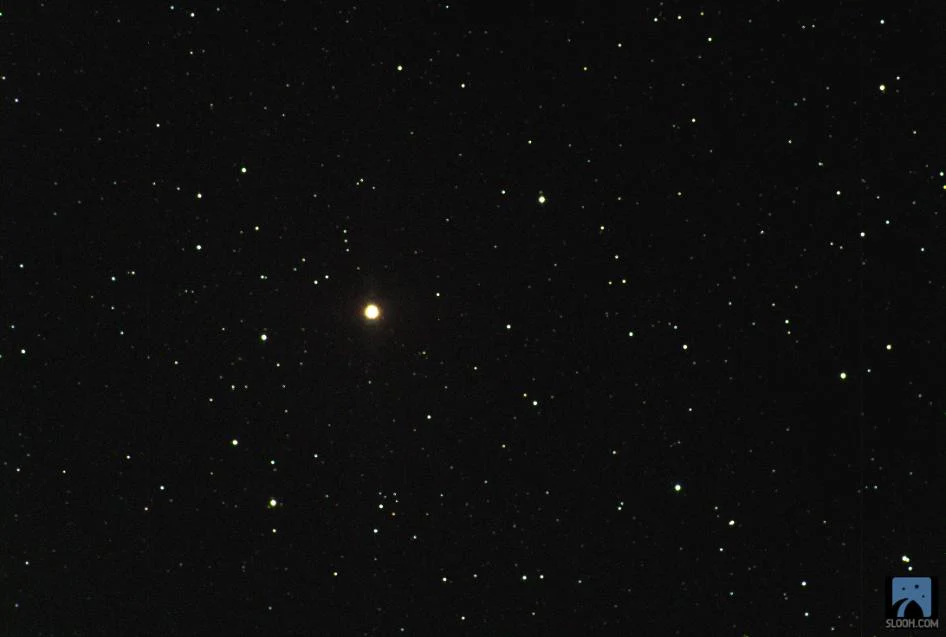
This image illustrates a specific case of a host star of a detected exoplanet and reinforces the physical meaning of the term fp: stars with planets are not a hypothesis but an observational fact.
3. A star with multiple exoplanets.
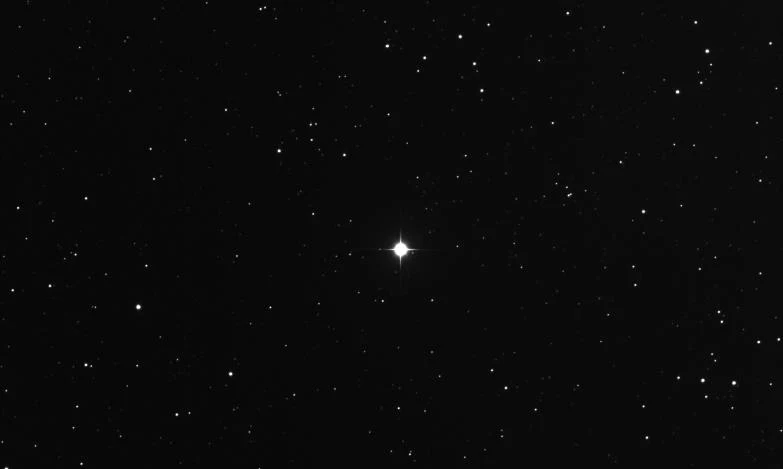
This observation represents a multiplanetary system and links to the concept of habitability beyond the mere existence of planets: in complex systems, the orbital architecture, the dynamical interactions and the conditions that favour long-term stability all matter.
4. A star field in the Milky Way to apply the count and the local calculation. Finally, the northern star field was imaged (Figure 4) in order to estimate the local N* by counting sources.
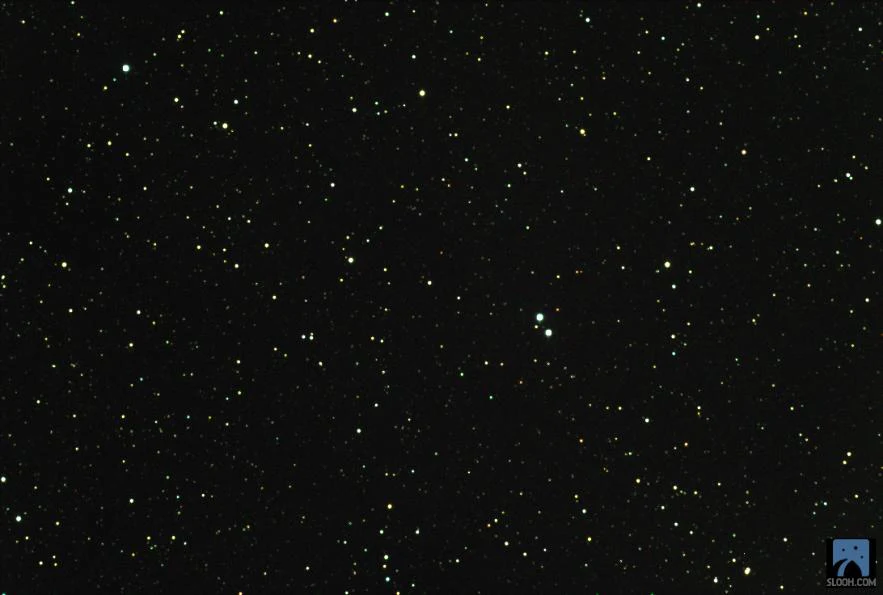
The count was made with the Aladin tool and its automatic source detection with SExtractor. The number of objects detected depends on the detection threshold adopted: with a lower threshold (threshold = 2) about 677 sources were obtained, while with a stricter threshold (threshold = 3) the number fell to 483 (Figure 5).
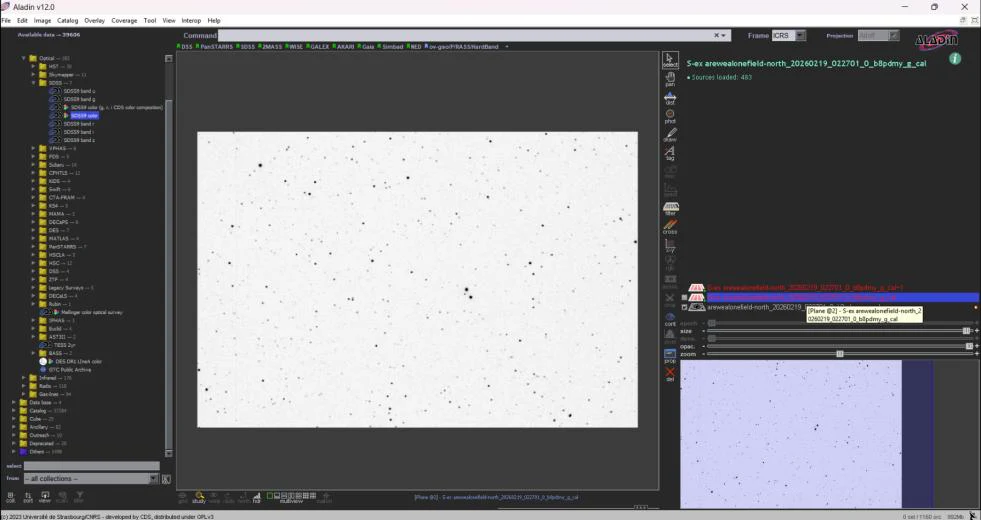
Since the aim of the exercise was to estimate the number of real stars while minimising false positives (noise, artefacts or marginal detections), a rounded, conservative value of Nlocal = 480* was adopted, representing the approximate number of stars detected in the field analysed. Applying the partial Drake equation:
Nhab,local = N*local · fp · ne = 480 · 1 · 0.22 = 105.6
In other words, in this small patch of sky one would statistically expect of the order of 100 potentially habitable planets. This result does not imply that those planets have been detected directly: it is a probabilistic extrapolation based on the mean fractions estimated for the galaxy.
Extrapolation to the Milky Way
If a field of barely 480 stars gives an expected value close to 100 potentially habitable planets, scaling the calculation to the total stellar content of the Milky Way gives:
Nhab,MW = (2.5 × 10¹¹) · 1 · 0.22 = 5.5 × 10¹⁰
This corresponds to roughly 55 billion potentially habitable planets in our galaxy.
Discussion: what do 55 billion really mean?
The result may seem overwhelming, but it is essential to interpret it correctly. This value does not represent confirmed planets, planets with life, planets with intelligence, let alone technological civilisations: it is a statistical estimate based exclusively on observable astronomical parameters.
The result indicates that the bottleneck of the problem does not seem to lie in the availability of physically suitable environments for life. If life is rare in the universe, its rarity would not lie in a shortage of “possible places” but in the later biological or evolutionary processes. Here the famous question asked by Enrico Fermi in 1950 reappears: “Where is everybody?”
Attempts at interstellar communication and the current debate
Humanity has not only tried to estimate how many civilisations might exist; it has also tried to communicate. The most notable milestones include:
- The Pioneer plaques (1972–1973). The Pioneer 10 and 11 probes carry plaques with symbolic information about humanity and the position of the Solar System in the galaxy.
- The Arecibo message (1974). A radio transmission sent towards the globular cluster M13, with coded information about DNA, numbers, atomic structure and the Solar System.
- SETI (Search for Extraterrestrial Intelligence). Programmes searching for artificial electromagnetic signals from deep space.
These milestones show that the search is not purely theoretical: humanity has begun to act as a detectable civilisation. In parallel, current research is aimed at detecting atmospheric biosignatures and technosignatures with advanced instrumentation. Current debates, including the scientific analysis of unidentified anomalous phenomena (UAP) and the declassification of data, show that the question remains alive in both academia and society. Any progress, however, must rest on verifiable evidence and rigorous methodology.
Conclusion
This work does not aim to give a definitive answer to the question that motivates it. Its contribution is to show that observational tools, statistical models and empirical data are now available that allow the question to be framed within quantitative astrophysics. The vastness of the Milky Way, combined with the abundance of planetary systems, suggests that the possibility of other habitable environments is real and numerous. Whether or not we are alone remains an open question, but for the first time in history it can be approached with numbers, telescopes and equations, and not only with imagination.
The search goes on and, with it, the steady expansion of our ability to measure, interpret and understand the cosmos.
References
- Cassan, A., et al. (2012). One or more bound planets per Milky Way star from microlensing observations. Nature, 481, 167–169.
- Licquia, T. C., & Newman, J. A. (2015). Improved estimates of the Milky Way’s stellar mass and star formation rate. The Astrophysical Journal, 806(1), 96.
- Mayor, M., & Queloz, D. (1995). A Jupiter-mass companion to a solar-type star. Nature, 378, 355–359.
- NASA Exoplanet Archive (2025). Caltech/IPAC.
- Petigura, E. A., Howard, A. W., & Marcy, G. W. (2013). Prevalence of Earth-size planets orbiting Sun-like stars. PNAS, 110(48), 19273–19278.