High energies · UNIR
Searching for TeV sources and characterising their SED: Cassiopeia A and Markarian 421
Two sources from the TeVCat catalogue, one Galactic and one extragalactic: their X-ray and gamma-ray observations, their spectral energy distribution obtained with the SSDC Sky Explorer and their fit with synchrotron self-Compton models compared with the literature.

Introduction
The universe is a particle accelerator far more powerful than any built on Earth, with objects able to boost protons and electrons to energies thousands of times higher than those of the LHC. When these particles interact with the matter or light around them, they produce gamma rays, the most energetic photons that can be detected.
TeVCat is a public catalogue that gathers all the objects detected in the TeV range. Two contrasting sources were chosen from it, one Galactic and one extragalactic. For each, its physical characteristics are described, its X-ray and gamma-ray observations are summarised, its spectral energy distribution (SED) is obtained with the SSDC Sky Explorer and a synchrotron self-Compton (SSC) model is fitted, comparing the results with the literature.
1. Cassiopeia A
Cassiopeia A (Cas A) is one of the youngest supernova remnants known in our galaxy: the shock wave generated by the explosion is still expanding and sweeping up the material that surrounded the progenitor star. Its kinematic age, obtained by extrapolating the motion of the ejecta knots backwards, is about 350 years (Fesen et al., 2006). It lies about 3.4 kpc from the Solar System (Reed et al., 1995) and belongs to the shell subtype: the emission comes mainly from the outer shock front rather than from a central compact object. That shock front acts as a particle accelerator through the mechanism of diffusive shock acceleration (DSA). Its progenitor is thought to have been a red supergiant stripped of its envelope by binary interaction (Hirai et al., 2020). The most relevant X-ray and gamma-ray observations of the source are summarised in Table A1 of Appendix A.
SSC model
Building the synchrotron self-Compton (SSC) model in the SED Builder presented a first technical difficulty: the tool requires a strictly positive redshift to calculate the luminosity distance and normalise the predicted flux. Since Cas A is inside our galaxy and has no significant cosmological redshift, a fictitious value, z = 0.001, was entered, with no physical meaning, only to satisfy the numerical requirement of the tool.
A second, more fundamental difficulty appeared when trying to fit the whole spectrum with a single SSC component: the parameters that reasonably reproduce the radio turned out to be incompatible with those needed to reproduce the hard X-rays. The former call for a weak magnetic field and a very extended emitting region; the latter for an amplified field in a compact zone. This tension is not an artefact of the fit but a known physical characteristic of Cas A: its synchrotron emission is not spatially homogeneous. Since the model of Atoyan et al. (2000), it has been recognised that at least two emission regions coexist: a diffuse one covering the whole shell and another concentrated in compact knots close to the shock front, where the polarimetric measurements of IXPE (Vink et al., 2022) confirm that the magnetic field is strongly amplified and turbulent.
To include that stratification, a two-zone model was built by superimposing two SSC components with different parameters:
- Diffuse shell: radius R = 2.6 pc and magnetic field B = 0.3 mG, values consistent with Araya and Cui (2010) and Saha et al. (2014).
- Compact knots: R = 0.1 pc and B = 3 mG, an order of magnitude higher, consistent with Atoyan et al. (2000) and with recent X-ray polarimetry.
Electrons with index α = 2.2 are used in the shell (MAGIC Collaboration et al., 2017) and a slightly harder α = 2.15 in the knots, and a cut-off energy of ~10 TeV, an intermediate value between the relic and freshly injected populations of Woo et al. (2024). The full set of parameters is given in Table B1 of Appendix B.
Results
The combined model (Figure 1) covers about nineteen orders of magnitude in energy. At low frequencies, the shell component reproduces the radio data well, including the flattening below 30 MHz attributable to synchrotron self-absorption. In the optical both components overlap, and in the hard X-rays the knot component reproduces the NuSTAR and INTEGRAL fluxes, where the shell model already falls several orders of magnitude below. In the gamma-ray range, the inverse-Compton peak of the compact component reaches the Fermi-LAT data at GeV and approaches the MAGIC and VERITAS points at TeV, although it stays systematically at the lower edge of the observed range.
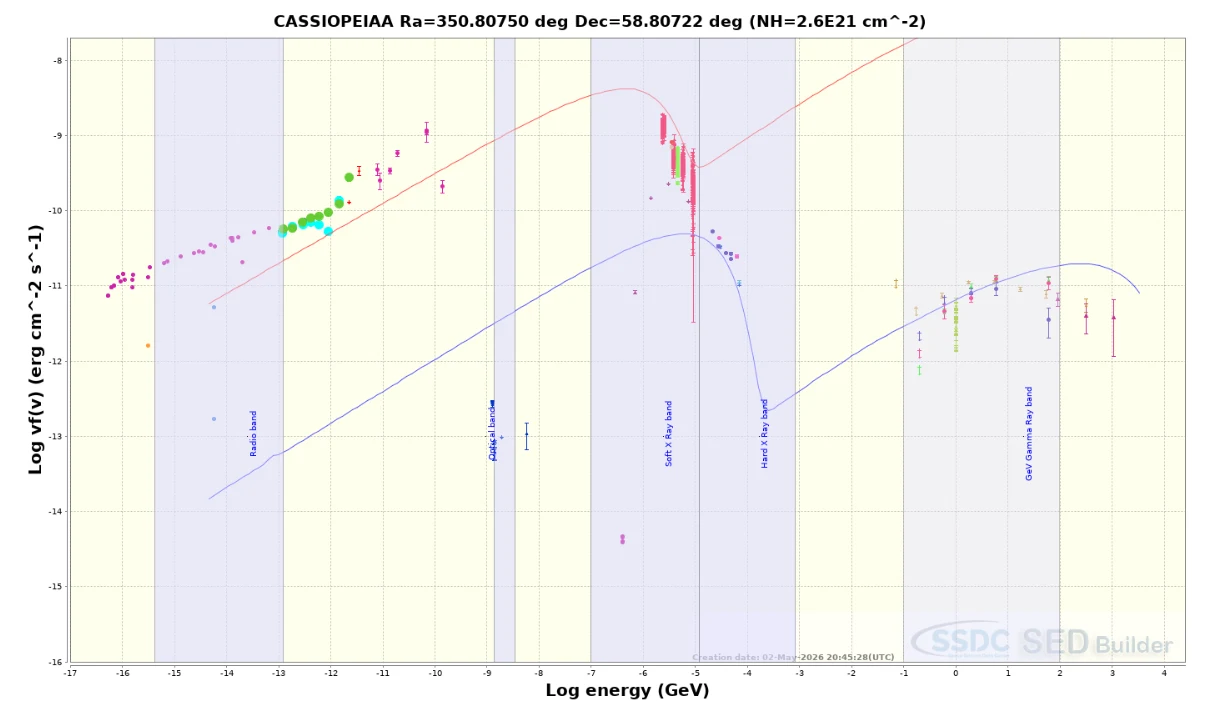
This limitation is consistent with the literature: Saha et al. (2014) and Abeysekara et al. (2020) show that reproducing the GeV–TeV data also requires a hadronic component, associated with the decay of neutral pions produced in proton–proton collisions with the circumstellar medium. The exponential cut-off detected by MAGIC Collaboration et al. (2017) at around 3.5 TeV is consistent with a spectrum of accelerated protons with a cut-off energy close to 10 TeV.
2. Markarian 421
Markarian 421 (Mrk 421) is a distant active galaxy classified as a blazar: an active galactic nucleus in which a relativistic jet, launched from the vicinity of the central black hole, points almost directly towards us. That orientation means that the emission we receive is strongly amplified by relativistic effects, which makes Mrk 421 one of the brightest blazars in the sky in X-rays and gamma rays and, since its discovery as the first extragalactic object detected in the TeV range, an essential reference for the study of high-energy processes (Abdo et al., 2011). It is relatively close, at a redshift z = 0.031, which corresponds to a luminosity distance of about 136 Mpc (Banerjee et al., 2019). The most relevant X-ray and gamma-ray observations are summarised in Table A2 of Appendix A.
SSC model
Unlike Cas A, building the SSC model for Mrk 421 was much more straightforward. The SED Builder is designed precisely for sources of this type, so a single-component SSC model is appropriate; the redshift z = 0.031 is the real measured value and the tool has no difficulty processing it.
As a starting point, the parameters published by Abdo et al. (2011) in their one-zone SSC characterisation of the average SED of Mrk 421 during the 2009 multi-frequency campaign were explored: B = 3.8 × 10⁻² G, δ = 21, R = 5.2 × 10¹⁶ cm and γmin = 8 × 10², with indices of the broken electron distribution extending up to γmax ~ 10⁸ (Table B2 of Appendix B). The resulting curve (Figure 2) correctly reproduces the global shape of the SED, with its two characteristic components, but the flux normalisation departs systematically from the data archived in the SSDC. This discrepancy is consistent with the strong variability of the source: the observations collected in the SSDC are not simultaneous with those of the 2009 campaign of Abdo et al. and mix high and low activity states of the blazar.
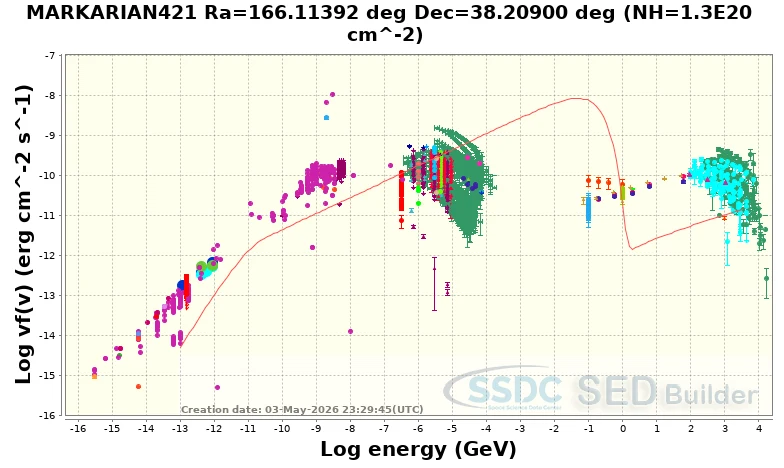
From that starting point, an iterative fit was carried out, modifying the parameters to reproduce at the same time the position of the two peaks of the SED and the flux normalisation of the archived data, taking as additional guidance the simultaneous multiband fit of Aleksić et al. (2012). The final values (R = 1016.5 cm, B = 0.05 G, δ = 22, α = 2.2, γmax = 10⁷; Table B3 of Appendix B) lie within the range published for Mrk 421 in states of low or moderate activity. In particular, Arbet-Engels et al. (2021), compiling several previous works, give typical ranges of δ ∈ [21, 51] and B ∈ [3, 8] × 10⁻² G for the one-zone SSC model of Mrk 421. The values adopted here fall at the lower end of those ranges, which is consistent with a quiescent state.
Results
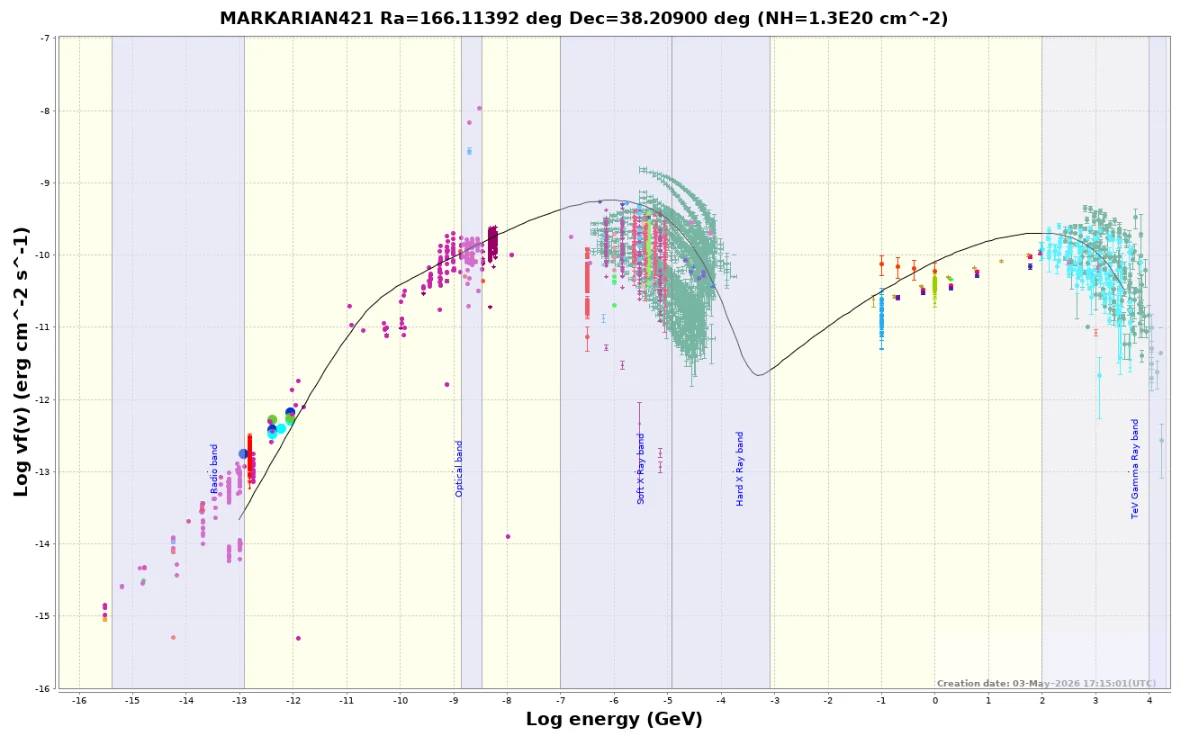
The final fit reproduces the whole observed spectrum, from radio to TeV (Figure 3). The synchrotron component closely follows the observed radio points, the peak of the first hump falls on the optical and ultraviolet data, and the X-ray region is well covered. In gamma rays, the inverse-Compton component passes through the Fermi-LAT data at GeV and approaches the MAGIC, VERITAS and LHAASO points at TeV. The scatter in the data reflects the strong variability of the source: the observations collected are not simultaneous and mix high and low activity states. The model therefore represents an approximate characterisation of the average emission rather than a snapshot of a particular moment of the jet; a truly rigorous fit would require simultaneous multiband observations.
Comparison and conclusions
The emitting region of Mrk 421 is extremely compact (R ≈ 0.01 pc) compared with that of Cas A (R ≈ 2.6 pc), and its magnetic field (~50 mG) is about 17 times stronger than the amplified field in the knots of the remnant (~3 mG), and it is also concentrated in a volume about a thousand times smaller than that of a knot and about ten million times smaller than that of the shell. This combination of compactness, moderately high magnetic field and relativistic Doppler amplification explains why such a distant extragalactic object (136 Mpc) is, paradoxically, one of the brightest TeV sources in the sky.
Unlike Cas A, where the SSC model showed intrinsic limitations that required hadronic components to reproduce the gamma-ray emission, in Mrk 421 the purely leptonic model satisfactorily reproduces the whole SED. This is consistent with the predominant interpretation in the literature: the gamma-ray emission of HBL blazars is mostly of leptonic SSC origin, and the same electrons that produce the synchrotron radiation scatter those photons by inverse Compton up to the TeV range (Aleksić et al., 2012; Abdo et al., 2011). Alternative lepto-hadronic models, such as that of Banerjee et al. (2019), can fit the data equally well but require proton densities that are hard to justify energetically.
The fit thus confirms that Mrk 421 behaves as a prototypical HBL blazar and that the one-zone SSC model adequately describes its multi-frequency emission, whereas Cas A requires a structurally richer treatment, reflecting the composite (leptonic and hadronic) nature of the emission of young supernova remnants.
Appendix A. X-ray and gamma-ray observations
| Instrument (reference) | Band | Main contribution |
|---|---|---|
| HEGRA (Aharonian et al., 2001) | TeV | First detection at very high energies; flux ~3 % of that of the Crab Nebula. |
| MAGIC and VERITAS (Albert et al., 2007; Acciari et al., 2010) | TeV | Confirmation of the TeV detection with better spatial resolution. |
| Suzaku (Maeda et al., 2009) | X-rays | Broadband imaging and spectroscopy of the remnant. |
| Fermi-LAT (Abdo et al., 2010; Yuan et al., 2013) | GeV | First detection at GeV; spectral break at a few GeV. |
| NuSTAR (Grefenstette et al., 2015) | Hard X-rays | Location of the regions where the most energetic electrons are accelerated. |
| INTEGRAL (Wang and Li, 2016) | Hard X-rays | Detection of the titanium-44 decay lines, a tracer of explosive nucleosynthesis. |
| Fermi-LAT + MAGIC (MAGIC Collaboration et al., 2017) | MeV–TeV | SED reconstructed from 60 MeV to 10 TeV; exponential cut-off at ~3.5 TeV compatible with protons accelerated up to ~10 TeV. |
| VERITAS + Fermi-LAT (Abeysekara et al., 2020) | GeV–TeV | Additional evidence for a hadronic scenario up to TeV. |
| IXPE (Vink et al., 2022; Mercuri et al., 2025) | X-rays | First polarimetric measurement of the shell; turbulent magnetic field at the shock front. |
| LHAASO (Cao et al., 2024, 2025) | Sub-TeV to TeV | Spectrum best described by a smoothly broken power law (Γ ≈ 1.90 → 3.41 around 0.63 TeV); TeV flux ~2 times higher than that measured by Cherenkov telescopes. |
Table A1. X-ray and gamma-ray observations of Cassiopeia A.
| Instrument (reference) | Band | Main contribution |
|---|---|---|
| Whipple 10 m (Punch et al., 1992) | TeV | First detection of an AGN at very high energies; discovery of Mrk 421 as a TeV blazar. |
| HEGRA, CAT, H.E.S.S. (Aharonian et al., 2002, 2005) | TeV | Confirmation of the TeV emission and first studies of variability and spectrum. |
| Whipple / HESS (Gaidos et al., 1996) | TeV | Detection of rapid variability on time scales of minutes during flares. |
| Fermi-LAT (Abdo et al., 2011) | GeV | Continuous monitoring at GeV; SED fitted to the high-energy peak. |
| MAGIC + multiband (Aleksić et al., 2012) | Optical–TeV | Simultaneous SSC modelling during the 2008 active state; direct reference for later fits. |
| XMM-Newton, NuSTAR, Swift-XRT (Markowitz et al., 2022; Gokus et al., 2024) | X-rays | Characterisation of intraday variability and of the correlation between flux and spectral hardness in high and low activity states. |
| ARGO-YBJ, HAWC, LHAASO (Cao et al., 2024) | TeV | Long-term monitoring at TeV with wide-field detectors, complementary to the Cherenkov campaigns. |
| IXPE (Di Gesu et al., 2022, 2023) | X-rays | First detection of X-ray polarisation in an HBL blazar; evidence of stratified synchrotron emission regions dominated by magnetic turbulence in the jet. |
| LST-1, SST-1M, ASTRI (Abe et al., 2025; Furniss, 2026) | TeV | Recent observations with the new generation of CTAO telescopes during a high-activity state. |
Table A2. X-ray and gamma-ray observations of Markarian 421.
Appendix B. Parameters of the SSC models
| Parameter | Diffuse shell | Compact knots | Justification |
|---|---|---|---|
| Region radius, R | 2.6 pc (log R = 18.9) | 0.1 pc (log R = 17.5) | Radius of the whole shell of the remnant (Reed et al., 1995); typical size of the bright knots (Atoyan et al., 2000). |
| Magnetic field, B | 0.3 mG | 3 mG | Mean B of the shell consistent with Araya and Cui (2010) and Saha et al. (2014); amplified B in the knots according to IXPE polarimetry (Vink et al., 2022). |
| Doppler factor, δ | 1 | 1 | No relativistic jet; trivial value. |
| Electron density, N | 1 cm⁻³ | 0.8 cm⁻³ | Adjusted empirically to reproduce the flux normalisation. |
| Spectral index, α | 2.2 | 2.15 | Shell value from the combined Fermi-LAT + MAGIC fit (MAGIC Collaboration et al., 2017); harder index in the knots, consistent with the freshly injected population of Woo et al. (2024). |
| Minimum Lorentz factor, γmin | 10² (~51 MeV) | 10² (~51 MeV) | Reasonable minimum threshold for considering electrons relativistic. |
| Maximum Lorentz factor, γmax | 107.3 (~10 TeV) | 107.35 (~11 TeV) | Electron cut-off energy consistent with MAGIC Collaboration et al. (2017) and Saha et al. (2014); intermediate value between the relic and freshly injected populations of Woo et al. (2024). |
| Cut-off energy, γcut | 107.3 | 107.35 | Consistent with γmax. |
| Synchrotron self-absorption | On (accurate mode) | On (accurate mode) | Needed to reproduce the flattening of the radio below 30 MHz. |
| Redshift, z | 0.001 (fictitious) | 0.001 (fictitious) | No physical meaning; entered only to satisfy the numerical requirement of the tool. |
Table B1. Values adopted to build the SSC model of Cassiopeia A in the SED Builder.
| Parameter | Value | Justification |
|---|---|---|
| Radius of the emitting region, R | 5.2 × 10¹⁶ cm (log R = 16.72) | Compact size of the blob, consistent with the rapid variability observed on time scales of hours. |
| Magnetic field, B | 3.8 × 10⁻² G | Typical field of HBL blazars in a quiescent state. |
| Doppler factor, δ | 21 | Relativistic amplification of the jet aligned with the line of sight. |
| Electron spectral index, p₁ | 2.2 | Distribution of relativistic electrons (low-energy index of the broken law). |
| Minimum Lorentz factor, γmin | 8 × 10² (log γmin = 2.9) | Injection threshold of relativistic electrons. |
| Maximum Lorentz factor, γmax | 10⁸ (log γmax = 8) | Controls the high-energy cut-off of the electron spectrum. |
| Electron density, N | Adjusted in the SSDC to reproduce the flux normalisation (N ≈ 0.03 cm⁻³) | Not reported directly by Abdo et al.; it depends on the normalisation scheme of each tool and is not directly comparable. |
| Redshift, z | 0.031 | Observed value of the source. |
Table B2. Parameters of the SSC model of Markarian 421 according to Abdo et al. (2011), implemented in the SED Builder.
| Parameter | Value |
|---|---|
| Radius of the emitting region, R | 1016.5 cm |
| Magnetic field, B | 0.05 G |
| Doppler factor, δ | 22 |
| Electron spectral index, α | 2.2 |
| Maximum Lorentz factor, γmax | 10⁷ |
Table B3. Final parameters of the SSC model of Markarian 421, fitted iteratively.
References
- Abdo, A. A., et al. (2010). Fermi-LAT discovery of GeV gamma-ray emission from the young supernova remnant Cassiopeia A. The Astrophysical Journal Letters, 710(1), L92–L97.
- Abdo, A. A., et al. (2011). Fermi Large Area Telescope observations of Markarian 421: The missing piece of its spectral energy distribution. The Astrophysical Journal, 736(2), 131.
- Abe, K., et al. (2025). VHE gamma-ray observations of bright BL Lacs with the Large-Sized Telescope prototype (LST-1) of the CTAO. Monthly Notices of the Royal Astronomical Society, 544, 669–686.
- Abeysekara, A. U., et al. (2020). Evidence for proton acceleration up to TeV energies based on VERITAS and Fermi-LAT observations of the Cas A SNR. The Astrophysical Journal, 894(1), 51.
- Acciari, V. A., et al. (2010). Observations of the shell-type supernova remnant Cassiopeia A at TeV energies with VERITAS. The Astrophysical Journal, 714(1), 163–169.
- Aharonian, F., et al. (2001). Evidence for TeV gamma ray emission from Cassiopeia A. Astronomy & Astrophysics, 370(1), 112–120.
- Aharonian, F., et al. (2002). Variations of the TeV energy spectrum at different flux levels of Mkn 421 observed with the HEGRA system of Cherenkov telescopes. Astronomy & Astrophysics, 393, 89–99.
- Aharonian, F., et al. (2005). Multi-wavelength observations of Mrk 421 in 2004 with HESS, RXTE, ROTSE-IIIb and KVA: Evidence for a relation of the X-ray and TeV emissions. Astronomy & Astrophysics, 437, 95–99.
- Albert, J., et al. (2007). Observation of VHE gamma-rays from Cassiopeia A with the MAGIC telescope. Astronomy & Astrophysics, 474(3), 937–940.
- Aleksić, J., et al. (2012). Mrk 421 active state in 2008: The MAGIC view, simultaneous multi-wavelength observations and SSC model constrained. Astronomy & Astrophysics, 542, A100.
- Araya, M., & Cui, W. (2010). Evidence for cosmic ray acceleration in Cassiopeia A. The Astrophysical Journal, 720(1), 20–25.
- Arbet-Engels, A., et al. (2021). The relentless variability of Mrk 421 from the TeV to the radio. Astronomy & Astrophysics, 647, A88.
- Atoyan, A. M., Aharonian, F. A., Tuffs, R. J., & Völk, H. J. (2000). On the gamma-ray fluxes expected from Cassiopeia A. Astronomy & Astrophysics, 355, 211–220.
- Banerjee, B., Joshi, M., Majumdar, P., Williamson, K. E., Jorstad, S. G., & Marscher, A. P. (2019). Time-dependent lepto-hadronic modeling of the emission from blazar jets with SOPHIE: The case of 3C 279, Mrk 421, and PKS 2155–304. Monthly Notices of the Royal Astronomical Society, 487(1), 845–858.
- Cao, Z., et al. (2024). The first LHAASO catalog of gamma-ray sources. The Astrophysical Journal Supplement Series, 271(1), 25.
- Cao, Z., et al. (2025). Broadband gamma-ray spectrum of supernova remnant Cassiopeia A. arXiv:2502.04848.
- Di Gesu, L., et al. (2022). The X-ray polarization view of Mrk 421 in an average flux state as observed by IXPE. arXiv:2209.07184.
- Di Gesu, L., et al. (2023). Discovery of X-ray polarization angle rotation in active galaxy Mrk 421. arXiv:2305.13497.
- Fesen, R. A., et al. (2006). The expansion asymmetry and age of the Cassiopeia A supernova remnant. The Astrophysical Journal, 645(1), 283–292.
- Furniss, A., for the VERITAS Collaboration (2026). An exceptional very-high-energy gamma-ray flare from Mrk 421 observed with VERITAS. The Astronomer’s Telegram, 17594, 1.
- Gaidos, J. A., et al. (1996). Very rapid and energetic bursts of TeV photons from the active galaxy Markarian 421. Nature, 383(6595), 319–320.
- Gokus, A., et al. (2024). Rapid variability of Markarian 421 during extreme flaring as seen through the eyes of XMM-Newton. Monthly Notices of the Royal Astronomical Society, 529(2), 1450–1462.
- Grefenstette, B. W., et al. (2015). Locating the most energetic electrons in Cassiopeia A. The Astrophysical Journal, 802(1), 15.
- Hirai, R., et al. (2020). Formation pathway for lonely stripped-envelope supernova progenitors: Implications for Cassiopeia A. Monthly Notices of the Royal Astronomical Society, 499(1), 1154–1171.
- Maeda, Y., et al. (2009). Suzaku X-ray imaging and spectroscopy of Cassiopeia A. Publications of the Astronomical Society of Japan, 61(6), 1217–1228.
- MAGIC Collaboration, et al. (2017). A cut-off in the TeV gamma-ray spectrum of the SNR Cassiopeia A. Monthly Notices of the Royal Astronomical Society, 472(3), 2956–2962.
- Markowitz, A. G., et al. (2022). Rapid X-ray variability in Mkn 421 during a multiwavelength campaign. arXiv:2206.03874.
- Mercuri, A., et al. (2025). Revisiting X-ray polarization of the shell of Cassiopeia A using spectropolarimetric analysis. arXiv:2504.07051.
- Punch, M., et al. (1992). Detection of TeV photons from the active galaxy Markarian 421. Nature, 358(6386), 477–478.
- Reed, J. E., Hester, J. J., Fabian, A. C., & Winkler, P. F. (1995). The three-dimensional structure of the Cassiopeia A supernova remnant. I. The spherical shell. The Astrophysical Journal, 440, 706.
- Saha, L., Ergin, T., Majumdar, P., Bozkurt, M., & Ercan, E. N. (2014). Origin of gamma-ray emission in the shell of Cassiopeia A. Astronomy & Astrophysics, 563, A88.
- Vink, J., et al. (2022). X-ray polarization detection of Cassiopeia A with IXPE. arXiv:2206.06713.
- Wang, W., & Li, Z. (2016). Hard X-ray emissions from Cassiopeia A observed by INTEGRAL. The Astrophysical Journal, 825(2), 102.
- Woo, J., et al. (2024). Spectrum and location of ongoing extreme particle acceleration in Cassiopeia A. arXiv:2410.16522.
- Yuan, Y., Funk, S., Jóhannesson, G., Lande, J., Tibaldo, L., & Uchiyama, Y. (2013). Fermi Large Area Telescope detection of a break in the gamma-ray spectrum of the supernova remnant Cassiopeia A. The Astrophysical Journal, 779(2), 117.