Planetary systems · UNIR
Orbital and spectral analysis of meteors
Orbital elements, origin criteria (Tisserand and Southworth–Hawkins), ablation, dynamic pressure and Ceplecha’s classification, and emission spectroscopy, applied to the deep-penetrating fireball SPMN051213 and to the Northern ω-Scorpiids.

1. Orbital elements and meteor showers
1.1. Main orbital elements of a meteor
To know where a space rock comes from and how it moves, its mathematical “identity card” has to be defined: the Keplerian orbital elements, which describe the shape, size and orientation of its path around the Sun.
| Element | Symbol | What it is |
|---|---|---|
| Semi-major axis | a | Sets the size of the orbit and its period (P = a3/2). |
| Eccentricity | e | Describes the shape of the orbit, from circular (e = 0) to elliptical (0 < e < 1). |
| Perihelion distance | q | Minimum distance to the Sun, q = a(1 − e). |
| Inclination | i | Angle of the orbit with respect to the Earth’s orbital plane (the ecliptic). |
| Longitude of the ascending node | Ω | Point where the orbit crosses the Earth’s orbital plane. |
| Argument of perihelion | ω | Orientation of the ellipse within its plane. |
Table 1. Keplerian orbital elements. Adapted from Ceplecha (1987) and Espartero and Madiedo (2016).
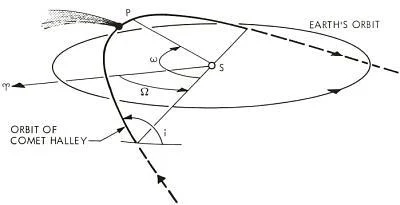
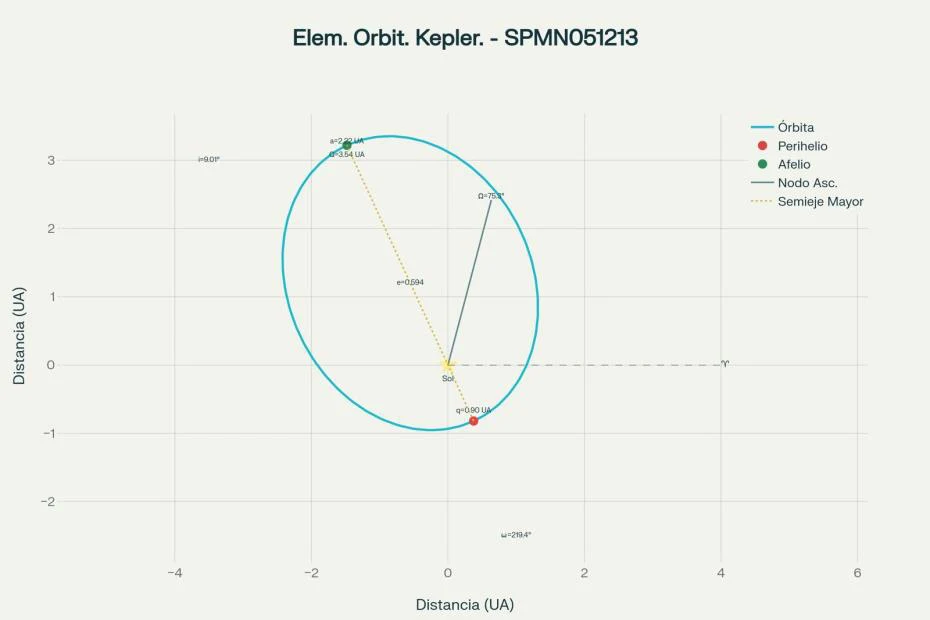
To illustrate how these elements define a real orbit, Appendix A includes Figure A.1, with the Keplerian path of the fireball SPMN051213.
1.2. Origin criteria and their mathematical basis
The origin of a meteoroid is established with two fundamental criteria, whose mathematical development is given in Appendices A.1.1 and A.1.2:
- Tisserand parameter (TJ). It is key to distinguishing comets from asteroids. If TJ > 3, the origin is asteroidal (as for the deep-penetrating fireball of 2013, with TJ = 3.24). If TJ < 2, the origin is cometary (Jupiter-family comets).
- Southworth and Hawkins criterion (DSH). It measures the similarity between the orbit of a meteor and the mean orbit of a known shower. An orbit is assigned to a shower if DSH < 0.15.
Application to the fireball SPMN051213. To apply these concepts, the data-reduction methodology of Ceplecha (1987) was used. The orbital and dynamic parameters of the deep-penetrating fireball SPMN051213 (Espartero et al., 2014) give a Tisserand parameter TJ = 3.24, which confirms its asteroidal origin. The details of this classification are given in Appendix A.2, and the geometry of its elements can be seen in Figure A.1, which shows its heliocentric orbit and the position of its main Keplerian parameters.
1.3. Definition and origin of meteor showers
A meteor shower (or stream) occurs when the Earth crosses a stream of debris in space. This debris consists of particles that share similar orbits, so that, from our point of view, they seem to come from the same point in the sky: the radiant.
The fundamental cause is the passage of the Earth through this stream of dust and small fragments, which orbit the Sun on a path similar to that of a parent body. The International Astronomical Union (IAU) currently catalogues hundreds of streams, although the major showers observed each year number between 10 and 12.
Types of parent bodies (Ceplecha, 1985):
- Cometary origin. This is the most common. Comets sublimate as they approach the Sun and release dust and gas that leave a trail of particles along their orbit. For example, the Daytime ζ-Perseids are a trail linked to the complex of comet Encke (Madiedo et al., 2016).
- Asteroidal origin. The parent body is a solid rock or an asteroid that has broken up. These particles are denser and less fragile. For example, the Northern ω-Scorpiids (NSC) were confirmed to be of asteroidal origin thanks to their high TJ and their dynamic behaviour in the atmosphere (Espartero and Madiedo, 2016).
| Meteor shower | Parent body | Approximate peak | Maximum zenithal hourly rate (ZHR) |
|---|---|---|---|
| Quadrantids | Asteroid 2003 EH1 | Early January | ~120 meteors/h |
| Lyrids | Comet Thatcher | Late April | ~18 meteors/h |
| Eta Aquariids | Comet Halley | Early May | ~60 meteors/h |
| Perseids | Comet Swift–Tuttle | Mid-August | ~100 meteors/h |
| Orionids | Comet Halley | Late October | ~23 meteors/h |
| Leonids | Comet Tempel–Tuttle | Mid-November | ~10–15 meteors/h |
| Geminids | Asteroid 3200 Phaethon | Mid-December | ~150 meteors/h |
Table 2. Characteristics of the main annual meteor showers. Compiled from the International Meteor Organization (IMO), the IAU Meteor Data Center and NASA/AMS information on meteor showers.
2. Ablation, fireballs and meteorites
2.1. The ablation process and luminosity
Ablation is the loss of mass through melting and vaporisation of the outer layers of the meteoroid as it enters the atmosphere. Entry at hypersonic speeds (between 11 and 72 km/s) produces an extreme compression of the air and a shock wave that converts kinetic energy into heat. This heating melts and vaporises the surface of the meteoroid and gives rise to key physical phenomena: air compression, extreme heating and the emission of light.
The total ablated mass (ma) can be estimated from the luminous intensity I(t) of the fireball, because the light emitted is proportional to the energy the meteoroid dissipates during ablation. The formal expression, based on integrating the radiated energy (Madiedo et al., 2016), and the definition of its parameters are given in Appendix B.1.1.
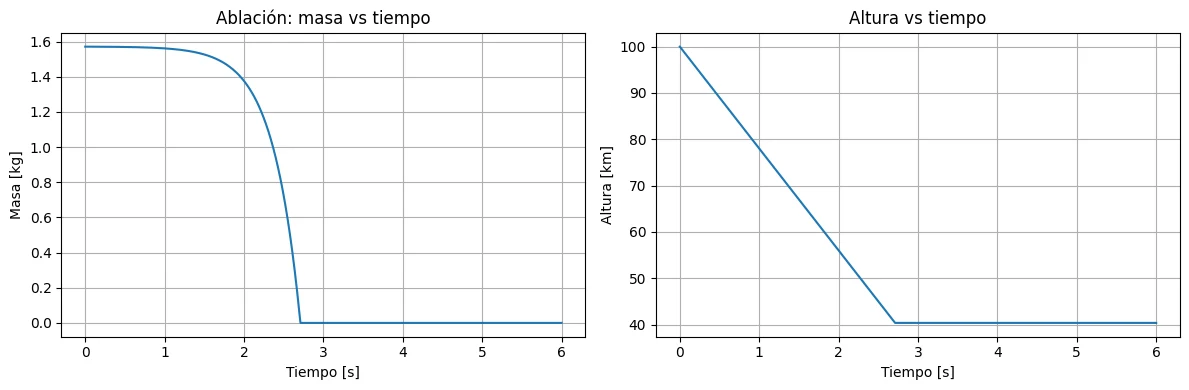
Ablation is not only a microscopic vaporisation process: it directly affects the dynamic evolution of the meteor during entry. To illustrate the relationship between mass loss and atmospheric descent, a simplified model was built (Figure 2).
2.2. Dynamic pressure, fragmentation and Ceplecha’s classification
Not all meteors are the same. The difference between seeing a fireball and finding a meteorite depends on a battle between the strength of the rock and the pressure of the air. A fireball is defined by a visual brightness criterion: any meteor that reaches an absolute magnitude of −4 or brighter (Espartero et al., 2014). A meteorite is produced only if the object manages to slow down to about 3 km/s before being completely consumed and enters the dark flight phase until it hits the ground (Ceplecha, 1987).
The dynamic-pressure criterion. Whether a meteor becomes a meteorite depends on the balance between the dynamic pressure (p) exerted by the atmosphere and the mechanical (tensile) strength of the rock. The maximum pressure the meteoroid experiences at the point of greatest stress is:
p = ρair · v²
where ρair is the air density and v the velocity (Madiedo et al., 2016).
Ceplecha’s physical classification (1985). Ceplecha established the worldwide standard for classifying these objects according to their ability to survive the atmosphere. From photographic data, he divided fireballs into four physical groups:
| Group | Typical composition | Density (ρ) | Does a meteorite fall? |
|---|---|---|---|
| Type I | Ordinary chondrite (solid rock) | ~3.7 g/cm³ | Yes. They are hard rocks and often reach the ground. |
| Type II | Carbonaceous chondrite (porous rock) | ~2.1 g/cm³ | Sometimes. They are more fragile, but the largest ones survive. |
| Type IIIA | Cometary (ball of dust and ice) | ~0.75 g/cm³ | No. They break up at high altitude. |
| Type IIIB | Soft cometary (Draconids) | < 0.3 g/cm³ | No. They are extremely fragile, like cosmic sugar lumps. |
Table 3. Classification of fireballs according to their structural strength and their ability to survive (Ceplecha, 1985).
The fall of a meteorite is determined mainly by composition (types I or II) and initial velocity: low velocities, below 25 km/s, favour survival. Fireballs of cometary origin (types III), even when bright, are completely consumed in the atmosphere (Ceplecha, 1985).
3. The spectrum of a meteor
3.1. Method of spectral determination and type of spectrum
The spectrum of a meteor is determined by high-speed spectroscopy, usually slitless, by coupling a diffraction grating to high-sensitivity cameras that record the event in fractions of a second. On passing through the grating, the light of the meteor is dispersed into its different wavelengths and produces a spectral image that can be analysed frame by frame.
Because the phenomenon is extremely fast (tens of km/s), the instrumentation requires cameras with high sensitivity and readout speed, an accurate wavelength calibration and spectrographs or diffraction gratings mounted directly on the optical system.
The result is an emission spectrum: bright lines on a dark background. These lines come from the plasma produced by ablation, in which the atoms and molecules of the meteoroid (and of the air) are excited and emit light at discrete wavelengths. They are the chemical fingerprint of the meteoroid.
3.2. Spectral information and its physico-chemical meaning
The emission lines make it possible to identify the elements present in the meteoroid. Among the most relevant multiplets are Na I-1 (sodium), Mg I-2 (magnesium) and Fe I (iron).
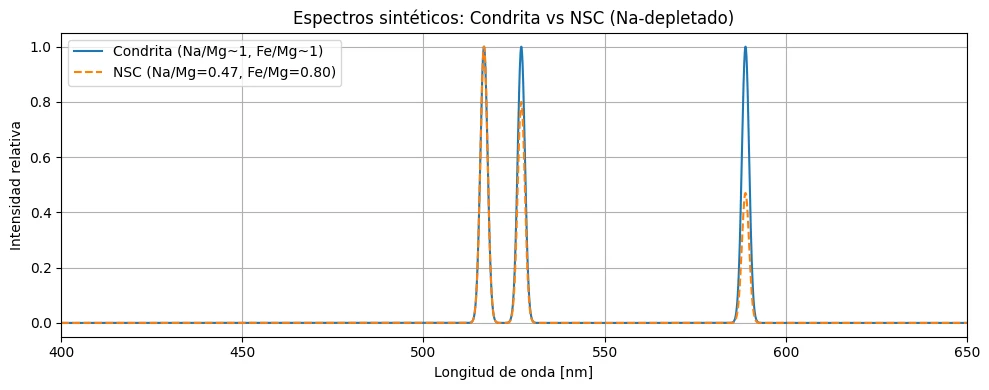
The relative intensity of these multiplets is key to distinguishing chondrites, asteroidal meteoroids and cometary fragments. For example, a marked sodium depletion (low Na/Mg) characterises the meteoroids of the Northern ω-Scorpiid stream (NSC), whereas ordinary chondrites show Na/Mg and Fe/Mg ratios close to unity.
To visualise these compositional differences quantitatively, a comparative synthetic spectrum was generated (Figure 3). The simulated spectra compare a chondritic meteoroid with Na/Mg ≈ 1 and Fe/Mg ≈ 1 with a meteoroid from the NSC stream with Na/Mg = 0.47 and Fe/Mg = 0.80, following the values of Espartero and Madiedo (2016), and they clearly show the smaller contribution of the Na I-1 multiplet in the latter.
3.3. Physical processes observable in the spectrum
The spectrum not only reveals the composition: it also allows the physical processes taking place during ablation to be inferred:
- Ionisation and recombination of the plasma.
- Fragmentation of the meteoroid (broadened lines or lines with multiple components).
- Interaction with the atmosphere (lines of ionised oxygen and nitrogen).
- The plasma temperature, from the relative intensity of the lines.
These processes help to characterise the physical type of the meteoroid and its structural behaviour during atmospheric entry.
Relation to dynamics and ablated mass. Spectroscopy is also essential for estimating the mass lost by ablation. The total luminous intensity (I) recorded is physically related to the mass-loss rate (dm/dt), the velocity (v) and the luminous efficiency (τ):
I = −½ · τ · v² · (dm / dt)
where I is the total luminous intensity, dm/dt the rate of mass loss by ablation, v the velocity of the meteor and τ the luminous efficiency (Ceplecha, 1985). From the spectrum and the photometry of the meteor, this relation makes it possible to estimate how much mass is lost by vaporisation and to assess its physical behaviour in the atmosphere.
Conclusion
Orbital, dynamic and spectral analysis allows the origin and physical nature of meteoroids to be characterised comprehensively. The Keplerian elements and the Tisserand and Southworth–Hawkins criteria identify where they come from; ablation and dynamic pressure describe their atmospheric evolution and possible survival; and the emission spectrum reveals their chemical composition and the physical processes that take place during entry.
Together, these methods provide a complete reconstruction of the behaviour of a meteor, from its heliocentric orbit to its final interaction with the Earth’s atmosphere.
Appendix A. Physical and mathematical basis and data for the fireball SPMN051213
A.1.1. Calculation of the Tisserand parameter (TJ)
The Tisserand parameter with respect to Jupiter (aJ ≈ 5.204 AU) is:
TJ = aJ / a + 2 · cos i · √[(a / aJ) · (1 − e²)]
Substitution and result for SPMN051213 (data from Espartero et al., 2014). With a = 2.36 AU, e = 0.619 and i = 8.99°:
TJ = 5.204 / 2.36 + 2 · cos(8.99°) · √[(2.36 / 5.204) · (1 − 0.619²)] ≈ 3.25
The small difference from the published value of 3.24 is due to rounding of the orbital data.
The Tisserand values of other events analysed confirm the asteroidal regime (TJ > 3):
- ZPE 2012 (Earth-grazing fireball of the ζ-Perseids): TJ = 3.31.
- NSC (average of the Northern ω-Scorpiids): TJ = 3.52.
- Fireball of 2013 (SPMN051213): TJ = 3.24.
All these values fall within the asteroidal regime (TJ > 3) and are distinct from a cometary origin.
A.1.2. Southworth and Hawkins orbital similarity criterion (DSH)
This criterion makes it possible to associate the orbit of an individual meteoroid (q, e, i, ω, Ω) with a known meteor stream by comparing it with the mean orbit of the shower (q′, e′, i′, ω′, Ω′). The dissimilarity is defined as:
DSH² = (e − e′)² + (q − q′)² + [2 sin(I/2)]² + [(e + e′)/2]² · [2 sin(Π/2)]²
where I is the angle between the planes of the two orbits and Π the difference between the longitudes of their perihelia, measured from the intersection of those planes.
Association criterion. The meteoroid is associated with the shower if the dissimilarity is low (DSH < 0.15). Some applications:
- Earth-grazing fireball ZPE 2012: DSH = 0.13, associated with the ζ-Perseid shower.
- ω-Scorpiids (core of the stream): DSH ≤ 0.07, a value that confirms a very close association.
A.2. Parameters of the fireball SPMN051213
The table includes not only orbital parameters but also dynamic or kinematic parameters that are essential for analysing atmospheric entry.
| Parameter | Symbol | Value | Unit |
|---|---|---|---|
| Tisserand parameter | TJ | 3.24 | — |
| Semi-major axis | a | 2.36 | AU |
| Eccentricity | e | 0.619 | — |
| Perihelion distance | q | 0.898 | AU |
| Geocentric velocity | vg | 29.5 ± 0.5 | km/s |
Table A.2. Data adapted from Espartero et al. (2014), processed with Python (Matplotlib and Astropy).
Appendix B. Physical and mathematical basis, dynamics and structural classification
B.1.1. Calculation of the ablated mass (ma)
The mass lost by the meteor can be calculated from its brightness. According to Madiedo et al. (2016), the ablated mass is obtained by integrating the radiated energy:
ma = 2 ∫ I(t) / (τ · v²) dt
where:
- I(t) is the luminous intensity (the brightness) at each instant, obtained from the absolute magnitude M through I = I₀ · 10−0.4·M, where I₀ is the intensity of a zero-magnitude meteor.
- v is the velocity of the meteor.
- τ is the luminous efficiency, which depends on velocity (Ceplecha and McCrosky, 1976).
Example from the ZPE 2012 paper. Applying this integration to real events makes it possible to quantify the mass loss. For the Earth-grazing ζ-Perseid fireball of 2012, Madiedo et al. (2016) found that the meteoroid lost an ablated mass of ma ≈ 260 ± 30 g.
References
- American Meteor Society (n.d.). Meteor Showers. AMS.
- Ceplecha, Z. (1985). Fireball information on meteoroids and meteorites. Bulletin of the Astronomical Institutes of Czechoslovakia, 36(4), 237–242.
- Ceplecha, Z. (1987). Geometric, dynamic, orbital and photometric data on meteoroids from photographic fireball networks. Bulletin of the Astronomical Institutes of Czechoslovakia, 38(4), 222–234.
- Ceplecha, Z., & McCrosky, R. E. (1976). Fireball end heights: A diagnostic for the structure of meteoric material. Journal of Geophysical Research, 81(35), 6257–6275.
- Espartero, F., Madiedo Gil, J. M., & Castro Tirado, A. J. (2014). A deep-penetrating fireball produced by an asteroidal meteoroid. 45th Lunar and Planetary Science Conference.
- Espartero, F. A., & Madiedo, J. M. (2016). The Northern ω-Scorpiid meteoroid stream: orbits and emission spectra. Earth, Moon, and Planets, 118(2), 81–89.
- International Meteor Organization (2024). Meteor Shower Calendar 2025 (IMO INFO(3-24)). IMO.
- International Astronomical Union, Meteor Data Center (n.d.). IAU Meteor Shower Database. IAU.
- Jet Propulsion Laboratory (n.d.). Diagram of the orbit of comet 1P/Halley illustrating the cometary elements.
- Madiedo, J. M., Espartero, F., Castro-Tirado, A. J., Pastor, S., & de los Reyes, J. A. (2016). An Earth-grazing fireball from the Daytime ζ-Perseid shower observed over Spain on 2012 June 10. Monthly Notices of the Royal Astronomical Society, 460(1), 917–922.